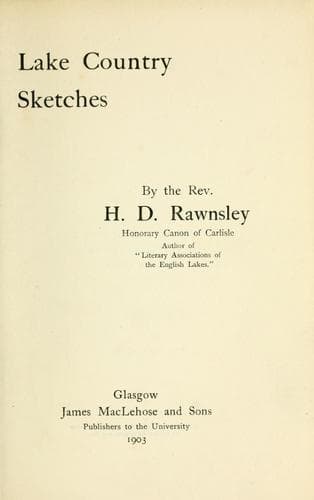
Lake country sketchesRawnsley, H. D. (Hardwicke Drummond)
General
Lake country sketches
Rawnsley, H. D. (Hardwicke Drummond)
Lake District (England); Wordsworth, William, 1770-1850 -- Homes and haunts -- England -- Lake District
When Smith lay dying, Pearson wrote a letter full of tender sympathy.
'So long as reason and memory remain, I shall never forget {129} the
many delightful hours we have passed together, whether in reading
some favourite poet or rambling among the beautiful scenes of
Nature.' 'I believe,' he added, 'that seldom have two persons come
together more in sympathy than we two, and I have often felt that my
separation from you was one of my greatest losses in leaving your
part of the country.'
Those rambles he mentions were walking-tours he took in 1817 through
Derbyshire, and in 1818 in the Craven country of Yorkshire. He kept
journals, and full of delightful observation of men and things they
are, redolent of real joy in sunshine and cloud. He writes, 'We
walked forward on this delightful morning with vigorous steps. The
lark was our constant companion, cheering us overhead with her song,
the fresh air of the mountains bathed our cheeks, there was freedom
from care and the feeling of liberty
'When the fretful stir
Unprofitable, and the fever of the world
Hung not upon the beatings of our hearts.'
'We felt something,' he adds, 'of
"That blessed mood
In which the burden of the mystery,
{130}
In which the heavy and the weary weight
Of all this unintelligible world
Is lightened: that serene and blessed mood
In which the affections gently lead us on."
At the end of his Derbyshire journal he says that 'the remembrance of
those happy days in Derbyshire will lie in the landscape of his
memory, like spots of stationary sunshine; they will be to him and
his friend as wells of pure water amid desert sands to which their
souls may fly for refreshment hereafter in hours of weariness amid
the din of towns and cities and the many shapes of joyless delight.'
Did ever city man take back to city roar and barrenness more quiet
and more profit from a country ramble?
In his last letter to Thomas Smith, he spoke of having left the
Manchester neighbourhood. In the autumn of 1820 he gave up his work
in the Manchester Bank. He never could think of his native vale
without a sense of heartsickness; his work was irksome and city life
hateful. In his poem to the river Winster dated 1821, he writes:
'And in the heavy time of after life,
When buried in the midst of toil and strife
In trading towns, if intermission sweet
I sought from my dull toil, my fancy fleet
{131}
Was straight amid thy vernal meads and flowers,
Thy hanging fields, wild woods, and leafy bowers.
Nor could I think of beauty on this earth,
But still 'twas seen with thee--as if thy birth
And mine had been together. Now at ease
And free to wander whereso'er I please,
What charms I find along thy simple stream,
Beloved Winster!'
Public-domain text, read in full here on John Shaqi.
Reviews
Reviews
No reviews yet
Be the first to share your thoughts on this work.
Join the Discussion
Join the discussion
Sign in to leave a comment or review.
Sign InorCreate an account