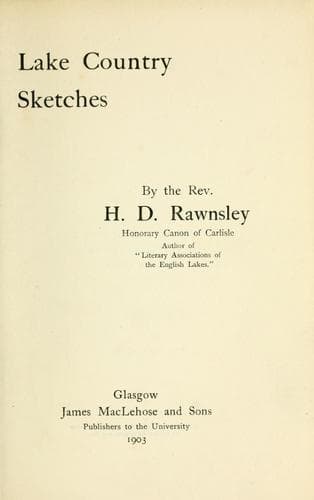
Lake country sketchesRawnsley, H. D. (Hardwicke Drummond)
General
Lake country sketches
Rawnsley, H. D. (Hardwicke Drummond)
Lake District (England); Wordsworth, William, 1770-1850 -- Homes and haunts -- England -- Lake District
There is no one in the county of Westmoreland to-day who would care
to take their children when plagued with the kink-cough up to
Cartmel-fell, on chance of clipping a hair from the cross on an ass's
back and then tying it round the bairn's neck as a sovereign remedy
for the troublesome whoop.
But if it had not been for William Pearson I doubt if we should have
known that the Winster dalesfolk, notwithstanding that the Cross was
set here in the clearing so many centuries ago, were actually
fire-worshippers and carrying on the rites of Baal with their
Beltane-fires as late as the year of Our Lord 1840. Pearson tells us
he talked with a farmer who had actually been present at the
sacrifice by fire of a calf in this neighbourhood, and that there
were two places within the memory of men then living, Fell Side in
Crosthwaite and Hodge Hill on Cartmel-fell, where, to prevent the
death of calves after birth, large fires were kindled in the open air
near to the farm house and a living calf laid upon them and burnt to
death.
As for the reality of this superstitious relic of sun-worship, in the
year 1840, William Pearson actually witnessed it here in Crosthwaite,
and, with a quotation from his paper {148} upon this point, I will
close this notice of his life and work:
'The Need Fire has again made its appearance. There is at present a
rumour of a dreadful epidemic among cattle, which has shown itself in
different places in this part of our country, to which it has been
coming slowly up from the South, where it prevailed last summer. On
Sunday afternoon, the 15th of last November, returning from Kendal by
way of Brigsteer, when I reached the brow of the hill that overlooks
that pleasant village, and from whence there is a glorious prospect,
I was somewhat surprised to see, in Crosthwaite, two or three large
masses of white smoke "rising up like the smoke of a furnace." I
thought it was lime-burning, from some kilns that are not usually
occupied. But when I reached Crosthwaite, I found myself in the
immediate neighbourhood of one of these "smokes," which was rising
very thickly below the Church Tower. I enquired of a young woman
standing in the road what was the meaning of all this smoke. "Oh,"
said she, "it is the Need Fire." Well, thought I, much as I have
heard of it, I have never seen the Need Fire. I will not miss this
opportunity of having ocular evidence of all its {149} mysteries. On
reaching che spot, I found the fire burning in the narrow lane called
Kirk Lane, within about twenty yards of the Kirk Tower, and about
half a dozen cattle huddled together and kept close to the fire, and
amongst the smoke, by a number of men and boys standing on each side
of them, in that narrow lane. Sometimes they drove them through the
fire, and such was the thickness of the smoke that I could scarcely
perceive the actors in this strange ceremony--men and cattle. "So,"
said I, "you are giving them a smoke." "Yes," replied the owner of
Public-domain text, read in full here on John Shaqi.
Reviews
Reviews
No reviews yet
Be the first to share your thoughts on this work.
Elsewhere in the archive
Join the Discussion
Join the discussion
Sign in to leave a comment or review.
Sign InorCreate an account