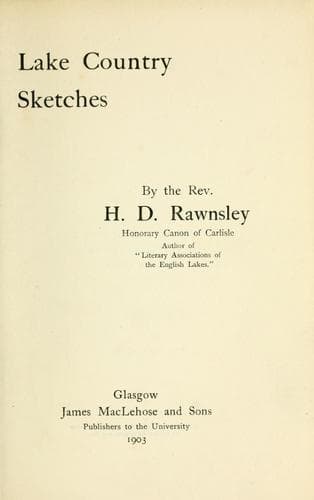
Lake country sketchesRawnsley, H. D. (Hardwicke Drummond)
General
Lake country sketches
Rawnsley, H. D. (Hardwicke Drummond)
Lake District (England); Wordsworth, William, 1770-1850 -- Homes and haunts -- England -- Lake District
Both men had won the hearts of the simple people far and near, and
ages after he is laid in earth, as he will be laid by the side of his
beloved wife, in the Threlkeld Churchyard, men will speak of 't'ald
Squire,' and enthusiastically tell of his hunting feats, and remember
how he loved his native village.
The love of hunting which John Crozier inherited from his father, who
lived at Gate Ghyll Farm on Blencathra's side, and who {193} turned
over to his son the mastership of what were then spoken of as 'the
Threlkeld dogs' in the year 1840, is a passion with our dales' folk
which only those who live amongst them can understand.
The 'varmint' is the natural enemy of the shepherd, and this adds
zest to the day's sport. In our churchwardens' accounts of old time
there appears the item 'A fox head, 21s.,' and though in other
chapelries 3s. 4d. appears to have been the price paid, such a
scourge must Reynard have become that the churchwardens felt they
were justified in giving a whole week's wage for the destruction of
one fox. Down at Shoulthwaite and, for aught I know, in other dales
a fox trap of masonry existed till of late years, built beehive
fashion with a hole in the top. If Reynard ventured in to the bait,
which was a fine fat hen, he was a prisoner; try to scale the walls
how he might the artful one was foiled; but to trap a fox goes
against the grain. There are certain things in which our hunt
differs from others. Class distinctions are unknown in the field.
The Master of the Hunt knows all by their Christian name. It is a
social gathering from daylight to dark. The luxury of horses, too,
is unknown. The {194} field are all running huntsmen of the type of
old Timothy, of whom Wordsworth wrote, in the year 1800--the
childless Timothy who took up his staff, and with the thought of his
last child's death heavy upon him could nevertheless not refuse the
invitation of 'the horn and the hark! hark-away,' and 'went to the
chase with a tear on his cheek.'
On that day when 'Skiddaw was glad with the cry of the hounds,' old
Timothy's daughter Ellen had been dead five months or more, or he
probably would not have followed the hunt, for there is a kind of
etiquette that the hunters in the dales observe, and they would no
more go a-hunting within a month after the death of their beloved,
than they would miss going to church on the Sunday following the
funeral. I remember once being asked by a widower, who was in great
sorrow and could not get away from his thoughts, whether he should
take what he knew to be the best physic--a day with the dogs. I
asked, 'What would your wife have said?' His answer came quite
straight: 'She wad hev clapped a bit o' lunch in my pocket, gi'en me
ma staff, shut door upon me, and telt me not to show my feace until
supper time.' I answered, 'That's enough,' and the man was a new
{195} being when he returned from the hunt, more able to wrestle with
his sorrows.
Public-domain text, read in full here on John Shaqi.
Reviews
Reviews
No reviews yet
Be the first to share your thoughts on this work.
Elsewhere in the archive
Join the Discussion
Join the discussion
Sign in to leave a comment or review.
Sign InorCreate an account