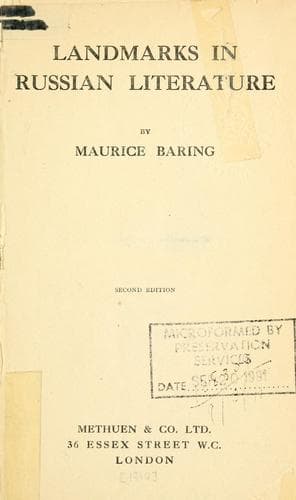
Russian literature -- 19th century -- History and criticism
The leading figure of the book is one Peter Verkhovensky, a political
agitator. He is unscrupulous, ingenious, and plausible in the highest
degree, as clever as a fiend, a complete egotist, boundlessly
ambitious, untroubled by conscience, and as hard as steel. His
prototype was Nachaef, an actual Nihilist. The ambition of this man is
to create disorder, and disorder once created, to seize the authority
which must ultimately arise out of any disorder. His means of effecting
this is as ingenious as Chichikov’s method of disposing of “dead
souls” in Gogol’s masterpiece. By imagining a central committee, of
which he is the representative, he organises a small local committee,
consisting of five men called “the Fiver”; and he persuades his dupes
that a network of similar small committees exists all over Russia. He
aims at getting the local committee entirely into his hands, and making
the members of it absolute slaves to his will. His ultimate aim is to
create similar committees all over the country, persuading people in
every new place that the network is ready everywhere else, and that
they are all working in complete harmony and in absolute obedience to
a central committee, which is somewhere abroad, and which in reality
does not exist. This once accomplished, his idea is to create disorder
among the peasants or the masses, and in the general upheaval to seize
the power. It is possible that I am defining his aim too closely, since
in the book one only sees his work, so far as one local committee is
concerned. But it is clear from his character that he has some big idea
at the back of his head. He is not merely dabbling with excitement in a
small local sphere, for all the other characters in the book, however
much they hate him, are agreed about one thing; that in his cold and
self-seeking character there lies an element of sheer enthusiasm.
The manner in which he creates disciples out of his immediate
surroundings, and obtains an unbounded influence over them, is by
playing on the peculiar weakness which I have already quoted as being
the characteristic of Chigalevism. He plays on the one-sidedness of the
Russian character; he plays on the fact that directly one single idea
takes possession of the brain of a certain kind of Russian idealist, as
in the case of Chatov, or Raskolnikov, for instance, he is no longer
able to control it. Peter works on this. He also works on the vanity of
his disciples, and on their fear of not being thought advanced enough.
Public-domain text, read in full here on John Shaqi.
Reviews
Reviews
No reviews yet
Be the first to share your thoughts on this work.
Elsewhere in the archive
Join the Discussion
Join the discussion
Sign in to leave a comment or review.
Sign InorCreate an account