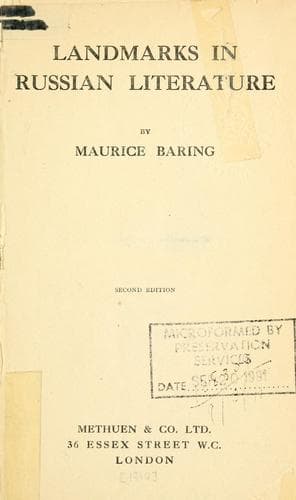
Russian literature -- 19th century -- History and criticism
With regard to Dostoievsky’s political opinions, he synthesised and
expressed them all in the speech which he made in June 1880, at Moscow,
in memory of Pushkin. “There was never,” he said, “a poet who possessed
such universal receptivity as Pushkin. It was not only that he was
receptive, but this receptivity was so extraordinarily deep, that
he was able to embrace and absorb in his soul the spirit of foreign
nations. No other poet has ever possessed such a gift; only Pushkin;
and Pushkin is in this sense a unique and a prophetic apparition,
since it is owing to this gift, and by means of it, that the strength
of Pushkin--that in him which is national and Russian--found
expression.... For what is the strength of the Russian national spirit
other than an aspiration towards a universal spirit, which shall
embrace the whole world and the whole of mankind? And because Pushkin
expressed the national strength, he anticipated and foretold its
future meaning. Because of this he was a prophet. For what did Peter
the Great’s reforms mean to us? I am not only speaking of what they
were to bring about in the future, but of what they were when they
were carried out. These reforms were not merely a matter of adopting
European dress, habits, instruction and science.... But the men who
adopted them aspired towards the union and the fraternity of the
world. We in no hostile fashion, as would seem to have been the case,
but in all friendliness and love, received into our spirit the genius
of foreign nations, of all foreign nations, without any distinction
of race, and we were able by instinct and at the first glance to
distinguish, to eliminate contradictions, to reconcile differences;
and by this we expressed our readiness and our inclination, we who
had only just been united together and had found expression, to bring
about a universal union of all the great Aryan race. The significance
of the Russian race is without doubt European and universal. To be a
real Russian and to be wholly Russian means only this: to be a brother
of all men, to be universally human. All this is called Slavophilism;
and what we call ‘Westernism’ is only a great, although a historical
and inevitable misunderstanding. To the true Russian, Europe and the
affairs of the great Aryan race, are as dear as the affairs of Russia
herself and of his native country, because our affairs are the affairs
of the whole world, and they are not to be obtained by the sword, but
by the strength of fraternity and by our brotherly effort towards the
universal union of mankind.... And in the long-run I am convinced that
we, that is to say, not we, but the future generations of the Russian
people, shall every one of us, from the first to the last, understand
that to be a real Russian must signify simply this: to strive towards
bringing about a solution and an end to European conflicts; to show to
Europe a way of escape from its anguish in the Russian soul, which is
Public-domain text, read in full here on John Shaqi.
Reviews
Reviews
No reviews yet
Be the first to share your thoughts on this work.
Elsewhere in the archive
Join the Discussion
Join the discussion
Sign in to leave a comment or review.
Sign InorCreate an account