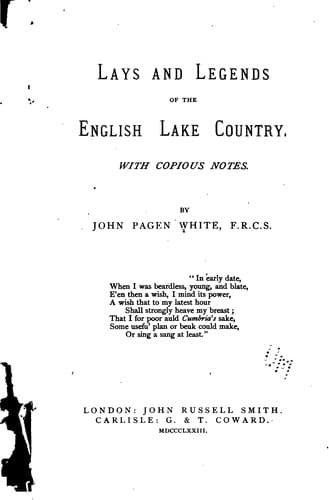
Lays and Legends of the English Lake Country: With Copious NotesWhite, John Pagen
General
Lays and Legends of the English Lake Country: With Copious Notes
White, John Pagen
Lake District (England) -- Poetry; Legends -- England -- Lake District
whence they could not by any means be effectually removed, the
common belief being that they were for that end indestructible, and
it was stoutly asserted that to whatever place they were taken, or
however used, they invariably reappeared in their old station by
the window.
The property of Calgarth came by purchase into the possession of
the late Dr. Watson, Lord Bishop of Llandaff, who built a mansion
upon the estate, where he passed much of the later period of
his life: and who lies buried in the neighbouring churchyard of
Bowness. The Bishop's grandson, Richard Luther Watson, Esquire, is
the present possessor.
It is believed that anciently a burial ground was attached to the
buildings of Old Calgarth; as when the ground has been trenched
thereabouts, quantities of human bones have frequently been turned
over and re-buried. There are now in the dairy of the Old Hall
two flat tombstones, with the name of Philipson inscribed upon
them, which not very many years ago were dug up in the garden
near the house; their present use being a desecration quite in
accordance with the associations which hang around the place. This
circumstance may afford a clue to the re-appearance of the skulls
so frequently, after every art of destruction had been tried upon
them, in the mysterious chambers of Old Calgarth Hall.
The old house at Armboth, on Thirlmere, has also the reputation of
being occasionally at midnight supernaturally lighted up for the
reception of spectres, which cross the lake from Helvellyn for some
mysterious purpose within its walls. The long low white edifice
lying close under the fells which rise abruptly behind it, with
the black waters of the lake in front, has something very gloomy
and weird-like about its aspect, which does not ill accord with
those superstitious ideas with which it is sometimes associated.
As Miss Martineau has said, "there is really something remarkable,
and like witchery, about the house. On a bright moonlight night,
the spectator who looks towards it from a distance of two or three
miles, sees the light reflected from its windows into the lake; and
when a slight fog gives a reddish hue to the light, the whole might
easily be taken for an illumination of a great mansion. And this
mansion seems to vanish as you approach,--being no mansion, but a
small house lying in a nook, and overshadowed by a hill."
The City of Wytheburn is the name given to a few houses, some of
them graced by native trees, and others by grotesquely cut yew
trees, distant about half a mile from the head of Thirlmere.
BRITTA IN THE TEMPLE OF DRUIDS.
(THE LAST HUMAN SACRIFICE.)
Public-domain text, read in full here on John Shaqi.
Reviews
Reviews
No reviews yet
Be the first to share your thoughts on this work.
Elsewhere in the archive
Join the Discussion
Join the discussion
Sign in to leave a comment or review.
Sign InorCreate an account