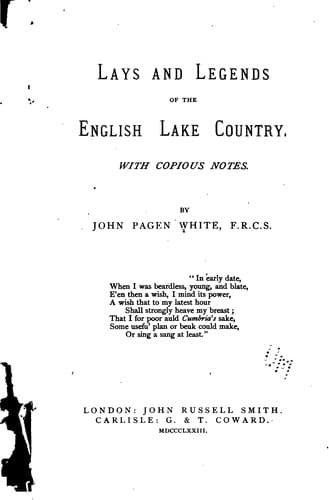
Lays and Legends of the English Lake Country: With Copious NotesWhite, John Pagen
General
Lays and Legends of the English Lake Country: With Copious Notes
White, John Pagen
Lake District (England) -- Poetry; Legends -- England -- Lake District
In a report to the government of Queen Elizabeth, of the date of
1588, inserted among the Burghley Papers, the son and heir of
this sharp-handed son-in-law of Curwen is mentioned in somewhat
detractory terms, in a passage which describes "the Pylle of
Folder," or Pile of Fouldrey. "The same Pylle is an old decayed
castell of 'the dowchie of Lancaster, in Furness Felles, where
one Thomas Preestone (a Papyshe Atheiste) is depute steward, and
comaunders the menrede and lands ther, which were sometime members
appertayninge to the Abbeye of Furnes.'"
Workington Hall, the seat of the Curwens, is a large quadrangular
building, with battlemented parapets, situated on a woody acclivity
over looking the river Derwent, at the east end of the town. It has
been almost entirely rebuilt within the present century. The old
mansion was castellated pursuant to the royal license granted by
Richard II., in 1379, to Sir Gilbert de Culwen. It is remarkable
for having been the first prison-house of the unfortunate Mary of
Scotland, after she had landed within the dominions of her rival.
Having left the Scottish shore in a small fishing boat, she landed
with about twenty attendants near the Hall on Sunday, May 16th,
1568; and was received by Sir Henry Curwen as became her rank and
misfortunes, and hospitably entertained by him, till she removed to
Cockermouth, on her route to Carlisle. The apartment in which the
Queen had slept was long preserved, out of respect to her memory,
as she had left it. But some recent alterations of the mansion
having become necessary, it was found that these could not be
effected without the destruction of that portion which had been so
long distinguished as the Queen's Chamber.
Mr. Denton, who wrote about the year 1676, says, "I do not know any
seat in all Britain so commodiously situated for beauty, plenty,
and pleasure as this is." And Mr. Sandford, who wrote about the
same time, has the following rapturous description, "And a very
fair mansion-house and pallace-like; a court of above 60 yards long
and 40 yards broad, built round about; garretted turret-wise, and
toors in the corner; a gate house, and most wainscot and gallery
roomes; and the brave prospect of seas and ships almost to the
house, the tides flowing up. Brave orchards, gardens, dovecoats,
and woods and grounds in the bank about, and brave corn fields and
meadows below, as like as Chelsay fields. And now the habitation
of a brave young Sq. his father Monsir Edward Curwen, and his
mother the grandchild of Sir Michael Wharton o' th' Wolds in
Yorkshire."
Even Mr. Gilpin, a century later, was struck with "its hanging
woods and sloping lawns," and speaks of its situation as "one of
the grandest and most beautiful in the country."
Public-domain text, read in full here on John Shaqi.
Reviews
Reviews
No reviews yet
Be the first to share your thoughts on this work.
Elsewhere in the archive
Join the Discussion
Join the discussion
Sign in to leave a comment or review.
Sign InorCreate an account