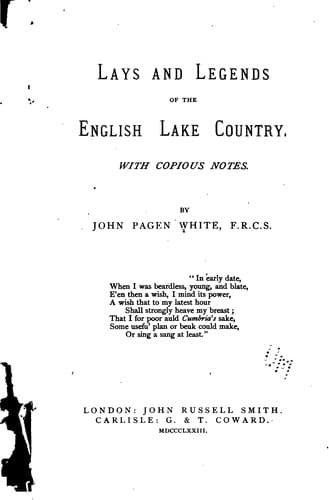
Lays and Legends of the English Lake Country: With Copious NotesWhite, John Pagen
General
Lays and Legends of the English Lake Country: With Copious Notes
White, John Pagen
Lake District (England) -- Poetry; Legends -- England -- Lake District
Even I, for little Ermengarde,
Would harp a life-long morrow,
But to reverse that doom so hard,
And lead her back from sorrow;
Mid happy thoughts again to beam,
All joyousness partaking;
But never more of Saints to dream
When summer morns are breaking.
NOTES TO "ERMENGARDE."
I.--St. Herbert's Isle, placed nearly in the centre of Derwent
Lake, derives its name from a hermit who lived there in the seventh
century, and had his cell on this island.
It contains about four acres of ground, is planted with firs
and other trees, and has a curious octagonal cottage built with
unhewn stones, and artificially mossed over and thatched. This
was erected many years ago by the late Sir Wilfred Lawson, to
whose representative the island at present belongs. A few yards
from its site are the ruins of the hermitage formerly occupied by
the recluse. These vestiges, being of stone and mortar, give the
appearance of its having consisted of two apartments; an outer one,
about twenty feet long and sixteen feet broad, which has probably
been his chapel, and another, of narrower dimensions, his cell,
with a little garden adjoining.
The scene around was well adapted to excite the most solemn
emotions, and was in unison with the severity of his religious
life. His plot of ground and the waters around him supplied his
scanty fare; while the rocks and mountains inspired his meditations
with the most sublime ideas of the might and majesty of the
Creator. It is no wonder that "St. Herbert, a priest and confessor,
to avoid the intercourse of man, and that nothing might withdraw
his attention from unceasing meditation and prayer, chose this
island for his abode."
There is no history of St. Herbert's life and actions to be met
with, or any tradition of his works of piety or miracles, preserved
by the inhabitants of the country. His contemporary existence with
St. Cuthbert, and his equo-temporary death with him obtained by the
prayers of the saint, at the time and in the manner related below,
according to the old legends, is all that is known of him.
Public-domain text, read in full here on John Shaqi.
Reviews
Reviews
No reviews yet
Be the first to share your thoughts on this work.
Elsewhere in the archive
Join the Discussion
Join the discussion
Sign in to leave a comment or review.
Sign InorCreate an account