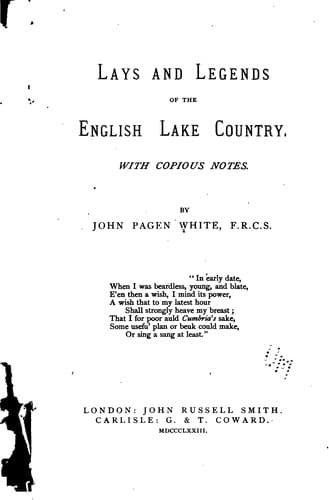
Lays and Legends of the English Lake Country: With Copious NotesWhite, John Pagen
General
Lays and Legends of the English Lake Country: With Copious Notes
White, John Pagen
Lake District (England) -- Poetry; Legends -- England -- Lake District
The religious house thus restored, consisting of a prior and six
Benedictine monks, was made a cell to the mitred Abbey of Saint
Mary, at York. And under this cell, Bishop Tanner says, there was a
small nunnery situated at Rottington, about a mile from St. Bees.
At the dissolution, the annual revenues of this priory, according
to Dugdale, were £143 17_s._ 2_d._; or, by Speed's valuation, £149
19_s._ 6_d._; from which it appears there were only two religious
houses in the county more amply endowed, viz. the priory of
Holme-Cultram, and the Priory of St. Mary, Carlisle; which latter
was constituted a cathedral church at the Reformation.
The conventual church of St. Bees is in the usual form of a cross,
and consists of a nave with aisles, a choir, and transepts, with a
massive tower, at the intersection, which until lately terminated
in an embattled parapet. This part of the building is now
disfigured by an addition to enable it to carry some more bells.
The rest of the edifice is in the early English style, and has been
thoroughly restored with great taste and feeling. On the south
side of the nave there was formerly a recumbent wooden figure, in
mail armour, supposed to have been the effigy of Anthony, the last
Lord Lucy of Egremont, who died A. D. 1368. The Lady Chapel, which
had been a roofless ruin for two centuries, was fitted up as a
lecture-room for the College established by Bishop Law in 1817.
The priors of this religious house ranked as barons of the Isle of
Man; as the Abbot of the superior house, St. Mary's, at York, was
entitled to a seat amongst the parliamentary barons of England.
As such he was obliged to give his attendance upon the kings and
lords of Man, whensoever they required it, or at least, upon every
new succession in the government. The neglect of this important
privilege would probably involve the loss of the tithes and lands
in that island, which the devotion of the kings had conferred upon
the priory of St. Bees.
In the library of the Dean and Chapter of Carlisle is the following
curious account of the discovery of a giant at St. Bees:--
"A true report of Hugh Hodson, of Thorneway, in Cumberland, to S^r
Rob Cewell (qy. Sewell) of a Gyant found at S. Bees, in Cumb'land,
1601, before X^t mas.
"The said Gyant was buried 4 yards deep in the ground, w^{ch} is
now a corn feild.
"He was 4 yards and an half long, and was in complete armour: his
sword and battle-axe lying by him.
"His sword was two spans broad and more than 2 yards long.
"The head of his battle axe a yard long, and the shaft of it all of
iron, as thick as a man's thigh, and more than 2 yards long.
"His teeth were 6 inches long, and 2 inches broad; his forehead was
more than 2 spans and a half broad.
"His chine bone could containe 3 pecks of oatmeale.
Public-domain text, read in full here on John Shaqi.
Reviews
Reviews
No reviews yet
Be the first to share your thoughts on this work.
Elsewhere in the archive
Join the Discussion
Join the discussion
Sign in to leave a comment or review.
Sign InorCreate an account