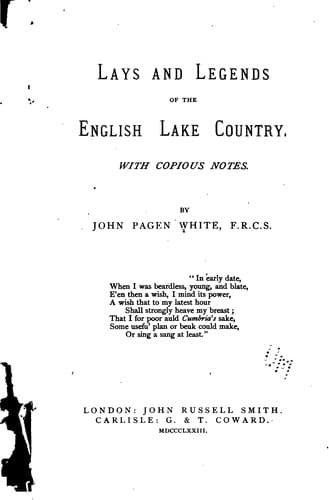
Lays and Legends of the English Lake Country: With Copious NotesWhite, John Pagen
General
Lays and Legends of the English Lake Country: With Copious Notes
White, John Pagen
Lake District (England) -- Poetry; Legends -- England -- Lake District
The ancient Manor house at Rydal stood in the Low Park, on the top
of a round hill, on the south side of the road leading from Keswick
to Kendal. But on the building of the new mansion on the north side
of the highway, in what is called the High Park, the manor house
became ruinous, and got the name of the Old Hall, which, says Dr.
Burn, in his time, "it still beareth." Even then there was nothing
to be seen but ruinous buildings, walks, and fish ponds, and other
marks of its ancient consequence; the place where the orchard stood
was then a large enclosure without a fruit tree in it, and called
the Old Orchard. At the present day few indications of its site
remain. Tradition asserts that it was deserted from superstitious
fears.
The present mansion was erected by Sir Michael le Fleming in the
last century. It stands on the north side of the road, on a slope
facing the south, is a large old fashioned building, and commands a
fine view of Windermere. Behind it rises Rydal Head, and Nab-Scar
a craggy mountain 1030 feet above the level of the sea. The Park
is interspersed with abundance of old oaks, and several rocky
protuberances in the lawn are covered with fine elms and other
forest trees. The Lord's Oak, a magnificent specimen, is built
into the wall on the lower side of the Rydal Road over which it
majestically towers. "The sylvan, or rather forest scenery of Rydal
Park," says Professor Wilson, "was, in the memory of living men,
magnificent, and it still contains a treasure of old trees."
The two waterfalls, the cascades of the rivulet which runs through
the lawn, are situated in the grounds. The way leads through the
park meadow and outer gardens by a path of singular beauty and
richness. They are in the opinion of Gilpin and other tourists
unparalleled in their kind. The upper fall is the finest, in the
eyes of those who prefer the natural accessories of a cascade: but
the lower one, which is below the Hall, is beheld from the window
of an old summer house. This affords a fine picture frame; the
basin of rock and the bridge above, with the shadowy pool, and the
overhanging verdure, constituting a perfect picture.
The heraldic distinction, the fret, is found more than once in
Furness Abbey, and is undoubtedly the ancient arms of le Fleming.
An entire seal appended to a deed from Sir Richard le Fleming
of Furness dated 44 Edward the Third (1371) shews a fret hung
cornerwise, the crest, on a helmet a fern, or something like it.
The seal annexed to another deed dated 6 Henry V. (1419) is the
same as above described; the motto, _S. Thome Flemin_, in Saxon
characters.
Public-domain text, read in full here on John Shaqi.
Reviews
Reviews
No reviews yet
Be the first to share your thoughts on this work.
Elsewhere in the archive
Join the Discussion
Join the discussion
Sign in to leave a comment or review.
Sign InorCreate an account