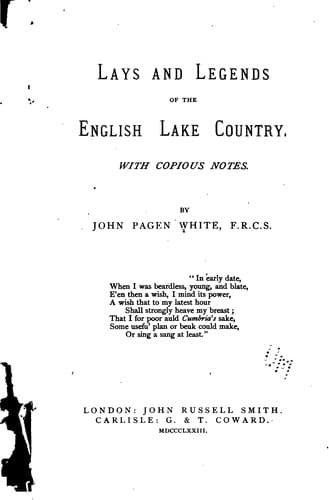
Lays and Legends of the English Lake Country: With Copious NotesWhite, John Pagen
General
Lays and Legends of the English Lake Country: With Copious Notes
White, John Pagen
Lake District (England) -- Poetry; Legends -- England -- Lake District
William of Malmesbury speaks of a Congress held at Dacre in the
year 934, when Constantine, king of Scotland, and his nephew
Eugenius, king of Cumberland, met king Athelstan, and did homage to
him at Dacre. This fact is singularly corroborated by there being
in the Castle a room called to this day the "room of the three
kings," while the historical fact itself is entirely forgotten
in the country. This proves the antiquity of the tradition,
which has survived the original building and attached itself to
the present, no part of which dates from an earlier period than
the fourteenth century. That Dacre was in those remote times a
place of some importance is evident from the meeting aforesaid.
The occasion appears to have been the defection of Guthred, with
Anlaff his brother, and Inguld king of York, when Athelstan levied
a great force, and entered Northumberland so unexpectedly, that
the malcontents had scarcely time to secure themselves by flight.
Guthred obtained protection under Constantine, king of Scotland,
to whom Athelstan sent messengers, demanding his surrender, or
upon refusal, he threatened to come in quest of him at the head of
his army. Constantine, although greatly piqued at this message,
yet afraid of the formidable arms of Athelstan, consented to meet
him at Dacre; to which place he came, attended by the then king of
Cumberland, where they did homage to Athelstan.
After the Conquest, if not before, Dacre was a mesne manor held of
the barons of Greystoke by military suit and service. The parish,
manor, rivulet, and castle, were all blended with the name of
the owners. Their arms, the pilgrim's scallop, may possibly have
been taken from their being engaged in Palestine; but as the name
of their place dates as far back as the time of Athelstan, the
Dacres no doubt took their name, like most of the families of the
district, from the place where they were settled, and with all
deference to the cross-legged knight[18] in the church, who may
or may not have battled at the siege of Acre, its present Norman
spelling is more likely to have arisen from the manner in which
it is entered in the Domesday Book than from any exploits of his
before that famous fortress. That they were men of high spirit and
enterprise, and favourites of the ladies, there exists convincing
evidence. Matilda, the great heiress of Gilsland,[19] was by
Randolph Dacre carried off from Warwick Castle, in the night-time,
while she was Edward the Third's Ward, and under the custody and
care of Thomas de Beauchamp, a stout Earl of Warwick; and Thomas
Lord Dacre dashingly followed the example of his ancestor, nearly
two centuries afterwards, by carrying off, also in the night time,
from Brougham Castle, Elizabeth of Greystoke, the heiress of his
Public-domain text, read in full here on John Shaqi.
Reviews
Reviews
No reviews yet
Be the first to share your thoughts on this work.
Elsewhere in the archive
Join the Discussion
Join the discussion
Sign in to leave a comment or review.
Sign InorCreate an account