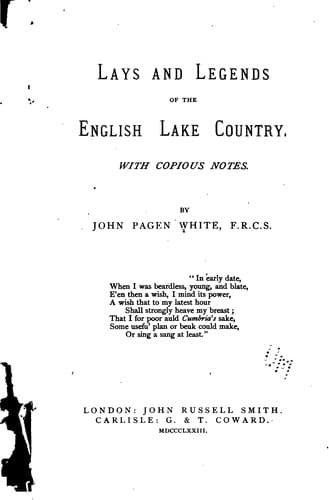
Lays and Legends of the English Lake Country: With Copious NotesWhite, John Pagen
General
Lays and Legends of the English Lake Country: With Copious Notes
White, John Pagen
Lake District (England) -- Poetry; Legends -- England -- Lake District
The original fortress of Greystock was built in the reign of Edward
III. by Lord William de Greystock, that nobleman having obtained
the king's license to castellate his manor-house of Greystock in
the year 1353. Being garrisoned for Charles I., it was destroyed by
a detachment of the Parliamentary army in June, 1648, except one
tower and part of another. The Castle was almost entirely rebuilt
about the middle of last century by the Hon. Charles Howard, and
additional extensions were subsequently made by his great-grandson,
the eleventh Duke of Norfolk, who bequeathed it to the present Mr.
Howard, by whom the work of renovation was continued and completed
in 1846. In the night of the 3rd and 4th of May, 1868, it was very
seriously damaged by fire.
Elizabeth Greystoke, Baroness Greystoke and Wemme, was a minor
at the time of her father's death. She was the only daughter of
Sir Robert Greystoke, knight, who died June 17th, 1483, in the
lifetime of his father, Ralph, seventeenth Baron Greystoke. By an
inquisition held after the death of that nobleman, it was found
that he died on Friday next after the Feast of Pentecost, in the
second year of King Henry VII., namely, June 1st, 1487. He was
succeeded by Elizabeth, his grand-daughter and heiress, who during
her minority was a ward of the crown, and had special livery of all
her lands in 1506. This lady married Thomas, ninth Baron Dacre of
Gillesland, and third Lord Dacre of the North; by which marriage
the Barony of Greystoke became united with that of Gillesland.
The nobleman in whose custody the King had placed his ward was
Henry the tenth Baron Clifford, better known as Lord Clifford
the Shepherd. He had married a cousin of Henry VII., and on the
accession of that monarch had been restored, by the reversal of
his father's attainder, to his honours and estates. Their sons had
been educated together, and brought up in habits of intimacy; and
the friendship thus formed in youth was continued after the one had
succeeded to the crown as Henry VIII., and the other had ceased
to be " Wild Henry Clifford," and had been advanced by his royal
kinsman and associate to the dignity of Earl of Cumberland.
Public-domain text, read in full here on John Shaqi.
Reviews
Reviews
No reviews yet
Be the first to share your thoughts on this work.
Elsewhere in the archive
Join the Discussion
Join the discussion
Sign in to leave a comment or review.
Sign InorCreate an account