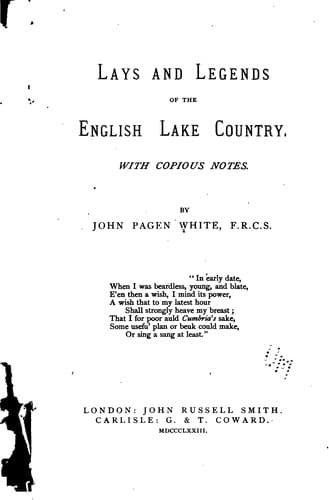
Lays and Legends of the English Lake Country: With Copious NotesWhite, John Pagen
General
Lays and Legends of the English Lake Country: With Copious Notes
White, John Pagen
Lake District (England) -- Poetry; Legends -- England -- Lake District
And his soul's allegiance fail'd not
That fair consort, all his days.
And their blissful love--avail'd not
Chance or time to quench its rays.
Love unto his gate had brought her
O'er the seas from far beyond.
And with love the Emir's daughter
Ruled the halls of Egremond.
But that kinsman, far divided
From them by remorse and shame,
Round his courts in secret glided
Ghost-like--nevermore the same:
Conscience-torn, repentant, weary,
Burning, longing for the close
Of that pilgrimage so dreary.
Power had come, but not repose.
Shadows the rebuked and chastened,
Worn-out warrior lowly laid.
And from Bega's cloisters hastened
Thrice the prior with his aid:
Thrice: And ere the leaves had faded,
Brave Lord Lucy clasped his breast;[23]
Kiss'd him; and the convent shaded
One more spirit into rest.
NOTES TO "THE LAY OF LORD LUCY OF EGREMOND."
The name of Egremont seems to be derived from its ancient
possessors, the Normans, and being changed by a trifling corruption
of their language, carries the same meaning, and signifies the
Mount of Sorrow.
The charter of Richard de Lucy, granted to the burgesses in
the time of King John, declares it to be given and confirmed
"burgensibus meis de _Acrimonte_," &c.
William the Conqueror having established himself on the throne of
England, and added the county of Cumberland, which he wrested from
Malcolm, king of Scotland, to his northern possessions; he gave it,
together with the barony of Westmorland, to Randolph or Ranulph
du Briquesard, also surnamed le Meschin, Vicomte du Bessin, elder
brother of William le Meschin. This nobleman was allied to the
Conqueror by marriage with his niece, and was one of his numerous
train of military adventurers. He was the first Norman paramount
feudatory of Cumberland. When Ranulph granted out to his several
retainers their respective allotments; reserving to himself the
forest of Inglewood, he gave to his brother, William le Meschin,
the great barony of Copeland, bounded by the rivers Duddon and
Derwent, and the sea. The latter seated himself at Egremont and
there erected a castle; and in distinction of this his baronial
seat, he changed the name of the whole territory to that of the
barony of Egremont. After possessing this estate with great power
for several years, and dying without male issue, it devolved to
his daughter Alice, married to Robert de Romili, Lord of Skipton.
They having no male issue, these two great baronies descended
to their only daughter Alice, who married William Fitz-Duncan,
Earl of Murray, nephew to David, King of Scots. By this marriage
there was issue a son, who died in infancy, and three daughters
who divided the vast inheritance. To Amabil, the second daughter,
the barony of Egremont came in partition; and by her marriage with
Public-domain text, read in full here on John Shaqi.
Reviews
Reviews
No reviews yet
Be the first to share your thoughts on this work.
Elsewhere in the archive
Join the Discussion
Join the discussion
Sign in to leave a comment or review.
Sign InorCreate an account