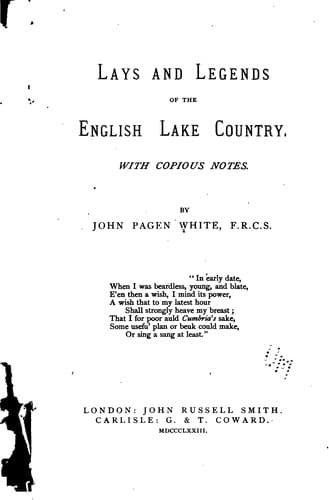
Lays and Legends of the English Lake Country: With Copious NotesWhite, John Pagen
General
Lays and Legends of the English Lake Country: With Copious Notes
White, John Pagen
Lake District (England) -- Poetry; Legends -- England -- Lake District
"Thus I have given," continues Mr. Clark, "the best account I can
procure of this wonderful appearance; let others determine what
it was. This country, like every other where cultivation has been
lately introduced, abounds in the _aniles fabellæ_ of fairies,
ghosts, and apparitions; but these are never even _fabled_ to
have been seen by more than one or two persons at a time, and the
view is always said to be momentary. Speed tells of something
indeed similar to this as preceding a dreadful intestine war. Can
something of this nature have given rise to Ossian's grand and
awful mythology? or, finally, Is there any impiety in supposing, as
this happened immediately before that rebellion which was intended
to subvert the liberty, the law, and the religion of England; that
though immediate prophecies have ceased, these visionary beings
might be directed to warn mankind of approaching _tumults_? In
short, it is difficult to say what it was, or what it was not."
Sir David Brewster, in his work on _Natural Magic_, after quoting
this narrative from Mr. James Clark, which he describes as "one of
the most interesting accounts of aerial spectres with which we are
acquainted," continues--"These extraordinary sights were received
not only with distrust, but with absolute incredulity. They were
not even honoured with a place in the records of natural phenomena,
and the philosophers of the day were neither in possession of
analagous facts, nor were they acquainted with those principles
of atmospherical refraction upon which they depend. The strange
phenomena, indeed, of the _Fata Morgana_, or the _Castles of the
Fairy Mor-Morgana_, had been long before observed, and had been
described by Kircher, in the 17th century, but they presented
nothing so mysterious as the aerial troopers of Souter Fell; and
the general characters of the two phenomena were so unlike, that
even a philosopher might have been excused for ascribing them to
different causes."
Public-domain text, read in full here on John Shaqi.
Reviews
Reviews
No reviews yet
Be the first to share your thoughts on this work.
Join the Discussion
Join the discussion
Sign in to leave a comment or review.
Sign InorCreate an account