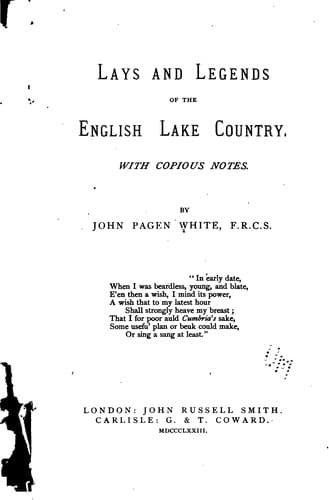
Lays and Legends of the English Lake Country: With Copious NotesWhite, John Pagen
General
Lays and Legends of the English Lake Country: With Copious Notes
White, John Pagen
Lake District (England) -- Poetry; Legends -- England -- Lake District
The accepted explanation of this appearance now is, that on the
evenings in question, the rebel Scotch troops were performing their
military evolutions on the west coast of Scotland, and that by
some peculiar refraction of the atmosphere their movements were
reflected on this mountain. Phenomena similar to these were seen
near Stockton-on-the-Forest, in Yorkshire, in 1792; in Harrogate,
on June 28th, 1812; and near St. Neot's, in Huntingdonshire, in
1820. Tradition also records the tramp of armies over Helvellyn, on
the eve of the battle of Marston Moor. To these may be added the
appearance of the Spectre of the Brocken in the Hartz Mountains;
and an instance mentioned by Hutchinson, that in the spring of the
year 1707, early on a serene still morning, two persons who were
walking from one village to another in Leicestershire, observed a
like appearance of an army marching along, till, going behind a
great hill, it disappeared. The forms of pikes and carbines were
distinguishable, the march was not entirely in one direction, but
was at first like the junction of two armies, and the meeting of
generals.
Aerial phenomena of a like nature are recorded by Livy, Josephus,
and Suetonius; and a passage in Sacred History seems to refer to a
similar circumstance. See Judges ix. 36.
Many in this country considered these appearances as ominous of the
great waste of blood spilt by Britain in her wars with America and
France. Shakespeare says, in _Julius Cæsar_,
"When these prodigies
Do so conjointly meet, let not men say,
---- ----they are natural;
For, I believe, they are portentous things
Unto the climate that they point upon."
FOOTNOTES:
[1] Whitaker gives the terms of this grant: "The king, in cons'on of
ye laudable and commendable service of his dere b'r Richard Duke of
Gloucester, as _for the encouragement of piety and virtue_ in the said
duke, did give and grant, etc., the honor, castle, manors, and demesnes
of Skipton, with the manor of Marton, etc., etc." Pat: Rolls, 15 Edw.
IV.
[2] A notable example of the piety of our ancestors is recorded in a
MS. Journal of a Voyage to India, still preserved in Skipton Castle,
made under the auspices of this Earl of Cumberland. It gives an account
of the proceedings of the Expedition on a Saturday and Sunday.
"Nov. 5. Our men went on shor and fet rys abord, and burnt the rest
of the houses in the negers towne; and our bot went downe to the
outermoste pointe of the ryver, and burnt a towne, and brout away all
the rys that was in the towne. The 6th day we servyd God, being Sunday."
In what manner they served God on the Sunday, after plundering and
burning two towns on the Saturday, the writer has not thought it
necessary to relate.
PAN ON KIRKSTONE.
Public-domain text, read in full here on John Shaqi.
Reviews
Reviews
No reviews yet
Be the first to share your thoughts on this work.
Join the Discussion
Join the discussion
Sign in to leave a comment or review.
Sign InorCreate an account