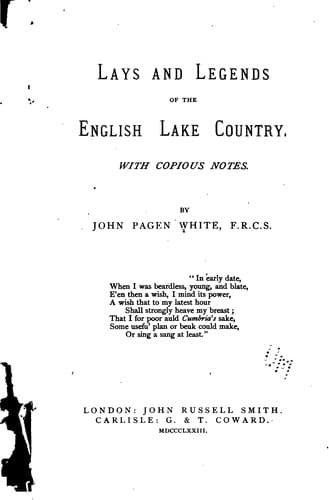
Lays and Legends of the English Lake Country: With Copious NotesWhite, John Pagen
General
Lays and Legends of the English Lake Country: With Copious Notes
White, John Pagen
Lake District (England) -- Poetry; Legends -- England -- Lake District
"Give me," she asked, "for me and mine,
O Lady of high Bretwalda's line!
Give, for His sake who succoured thee,
A shelter for these maids and me."--
Then sew'd, and spun, and crewl-work wrought,[3]
And served the poor they meekly taught,
These virgins good; and show'd the road
By blameless lives to Heaven and God.
They won from rude men love and praise;
They lived unmoved through evil days;
And only longed for a home to rise
To store up treasures for the skies.
That pious wish the Lady's bower
Has reached; and forth she paced the tower:--
"My gracious Lord! of thy free hand
Grant this good Saint three roods of land.
"Three roods, where she may rear a pile,
To sing God's praise through porch and aisle;
And, serving Him, us too may bless
For sheltering goodness in distress."
The Earl he turned him gaily near,
Laughed lightly in his Lady's ear--
"By this bright Eve of blessed St. John!
I'll give--what the snow to-morrow lies on."
His Lady roused him at dawn with smiles--
"The snow lies white for miles and miles!"
From loophole and turret he stares on the sight
Of Midsummer-morning clothed in white.
"--Well done, good Saint! the lands are thine.
Go, build thy church, and deck thy shrine.
I 'bate no jot of my plighted word,
Though lightly spoken and lightly heard.
"If mirth and my sweet Lady's grace
Have lost me many a farm and chace,
I know that power unseen belongs
To holy ways and Christian songs.
"And He, who thee from wind and wave
Deliverance and a refuge gave,
When we must brave a gloomier sea,
May hear thy prayers for mine and me."
NOTES TO "ST. BEGA AND THE SNOW MIRACLE."
The remains of the Monastery of St. Bees, about four miles south
of Whitehaven, stand in a low situation, with marshy lands to the
east, and on the west exposed to storms from the Irish Channel.
In respect to this religious foundation, Tanner says, "Bega, an
holy woman from Ireland is said to have founded, about the year
650, a small monastery in Copeland, where afterwards a church was
built in memory of her. This religious house being destroyed by the
Danes, was restored by William, brother to Ranulph de Meschines,
Earl of Cumberland, in the time of King Henry I., and made a cell
for a prior and six Benedictine monks, to the Abbey of St. Mary,
York."
The earliest documents connected with this place call it
_Kirkby-Begogh_, the market town of St. Bega; and _St. Bee_, or
_St. Bees_, the Saint's house or houses, names given to it _after_
the Irish Saint resided there.
St. Bega is said to have been the daughter of an Irish king, "who
was a Christian, and an earnest man, to boot." He wished to marry
his daughter to a Norwegian prince; but she, having determined
to be a nun, ran away from her father's house, and joining some
strange sailors, took ship, and sailed to the coast of Cumberland.
Public-domain text, read in full here on John Shaqi.
Reviews
Reviews
No reviews yet
Be the first to share your thoughts on this work.
Elsewhere in the archive
Join the Discussion
Join the discussion
Sign in to leave a comment or review.
Sign InorCreate an account