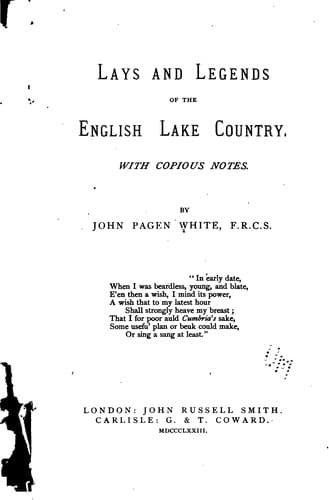
Lays and Legends of the English Lake Country: With Copious NotesWhite, John Pagen
General
Lays and Legends of the English Lake Country: With Copious Notes
White, John Pagen
Lake District (England) -- Poetry; Legends -- England -- Lake District
But gracious spirits of the light
Shall call a welcome down
On her, the beauteous lady bright,
And lead her to her own.
Not to that home o'er which the tide
Unceasing heaves and rolls;
But through that porch which opens wide
Into the land of souls.
NOTES TO "BEKAN'S GHYLL."
In the Chartulary of Furness Abbey, some rude Latin verses, written
by John Stell a monk, refer to a plant called _Bekan_, which at
some remote period grew in the valley in great abundance, whence
the name of Bekansghyll was anciently derived. The etymology is
thus metrically rendered:
"Hæc vallis, tenuit olim sibi nomen ab herba
Bekan, qua viruit; dulcis nunc tunc sed acerba,
Inde domus nomen Bekanes-gill claruit ante."
This plant "whose juice is now sweet, but was then bitter," is
assumed to be one of the species of Nightshade which are indigenous
in the dell and flourish there in great luxuriance; probably the
Solanum Dulcamara, the bitter-sweet or woody nightshade, although
the Atropa Belladonna, the deadly nightshade, also grows among the
ruins of the Abbey. This "lurid offspring of Flora," as Mr. Beck
calls it, the emblem of sorcery and witchcraft, might well give the
name of Nightshade to that enchanting spot. But what authority the
monks may have had for their derivation it is now impossible to
ascertain. Various glossaries and lexicons are said to have been
consulted for _bekan_, as signifying the deadly nightshade but
without effect; "and after all," says Mr. Beck, "I am inclined to
believe that Beckansgill is a creation of the monastic fancy."
Bekan is Scandinavian, and a proper name: and has probably been
localised in this district by the Northmen from the period of its
colonisation. It is said to have been quite in accordance with
the practice of these rovers to give the name of their chiefs not
only to the mounds in which they were buried, but also in many
cases to the valley or plain in which these were situated, or in
which was their place of residence; or to those ghylls or small
ravines, which, with the rivers or brooks, were most frequently the
boundaries of property. Bekan's gill may be associated in some way
with one of the northern settlers whose name has thus far outlived
his memory in the district.
Public-domain text, read in full here on John Shaqi.
Reviews
Reviews
No reviews yet
Be the first to share your thoughts on this work.
Elsewhere in the archive
Join the Discussion
Join the discussion
Sign in to leave a comment or review.
Sign InorCreate an account