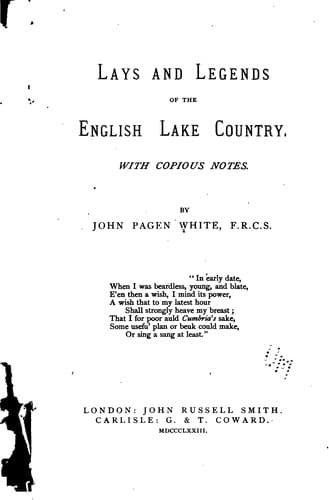
Lays and Legends of the English Lake Country: With Copious NotesWhite, John Pagen
General
Lays and Legends of the English Lake Country: With Copious Notes
White, John Pagen
Lake District (England) -- Poetry; Legends -- England -- Lake District
It is not at all likely that these calamitous visitations were
confined to the towns and villages. Although few traces may be
found of this frightful disease having invaded the more remote and
scattered population of the dales. Records of isolated cases might
easily be lost in the course of ages; and, as mere memorials of
domestic affliction, were not likely to be preserved in families.
Yet tradition has its utterances where purer history fails. On the
side of Lingmoor in Great Langdale, a small stone-fenced enclosure,
a few feet across, of green and shining laurels, indicates a spot
which the pestilence had reached. This bright circular patch of
evergreens is very conspicuous amid the ferns, from the heights
on the opposite side of the valley. On a near approach, the
foundations of what appear to be the remains of an ancient dwelling
may be traced at a little distance from it. Still more distant are
the ruins of one or two deserted cottages, where the sheep pasture
along the base of the mountain. What has been gathered from the
dalespeople about the laurels, so singular in such a spot, is, that
in the time of the great plague in England a woman and her son
occupied a cottage near the place. The youth went from this remote
district, in the spirit of enterprise, to push his fortunes in
London, was smitten by the pestilence, and died. After a time some
clothes and other things belonging to him were sent to his home
among the hills, infected the mother, and spread terror throughout
the neighbourhood. The woman having fallen a victim to the disease,
so great was the dread of the pestilence that the ordinary rites
of burial could not be obtained for her. The body could not be
borne for interment in consecrated ground. It mouldered away, it
is supposed, on the spot which to this day is marked by the little
enclosure of evergreens, a memorial of the fearful visitation in
the lonely dale.
One of the most pleasing characteristics of manners in secluded
and thinly-peopled districts, is a sense of the degree in which
human happiness and comfort are dependent on the contingency of
neighbourhood. This is implied by a rhyming adage common here,
"_Friends are far, when neighbours are nar_" (near). This mutual
helpfulness is not confined to out-of-doors work; but is ready
upon all occasions. Formerly, if a person became sick, especially
the mistress of a family, it was usual for those of the neighbours
who were more particularly connected with the party by amicable
offices, to visit the house, carrying a present; this practice,
which is by no means obsolete, is called _owning_ the family,
and is regarded as a pledge of a disposition to be otherwise
serviceable in a time of disability and distress.
THE VALE OF SAINT JOHN.
Public-domain text, read in full here on John Shaqi.
Reviews
Reviews
No reviews yet
Be the first to share your thoughts on this work.
Elsewhere in the archive
Join the Discussion
Join the discussion
Sign in to leave a comment or review.
Sign InorCreate an account