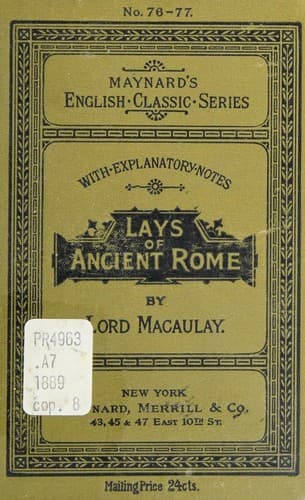
Lays of Ancient RomeMacaulay, Thomas Babington Macaulay, Baron
History
Lays of Ancient Rome
Macaulay, Thomas Babington Macaulay, Baron
Rome -- History -- Poetry
The Claudian triumphs all were won within the city towers;
The Claudian yoke was never pressed on any necks but ours.
A Cossus, like a wild cat, springs ever at the face;
A Fabius rushes like a boar against the shouting chase;
But the vile Claudian litter, raging with currish spite,
Still yelps and snaps at those who run, still runs from those who
smite.
So now 'twas seen of Appius. When stones began to fly,
He shook, and crouched, and wrung his hands, and smote upon his
thigh.
"Kind clients, honest lictors, stand by me in this fray!
Must I be torn in pieces? Home, home the nearest way!"
While yet he spake, and looked around with a bewildered stare,
Four sturdy lictors put their necks beneath the curule chair;
And fourscore clients on the left, and fourscore on the right,
Arrayed themselves with swords and staves, and loins girt up to
fight.
But, though without or staff or sword, so furious was the throng,
That scarce the train with might and main could bring their lord
along.
Twelve times the crowd made at him; five times they seized his
gown;
Small chance was his to rise again, if once they got him down:
And sharper came the pelting; and evermore the yell,--
"Tribunes! we will have Tribunes!"-- rose with a louder swell:
And the chair tossed as tosses a bark with tattered sail
When raves the Adriatic beneath an eastern gale,
When Calabrian sea-marks are lost in clouds of spume,
And the great Thunder-Cape has donned his veil of inky gloom.
One stone hit Appius in the mouth, and one beneath the ear;
And ere he reached Mount Palatine, he swooned with pain and fear.
His cursed head, that he was wont to hold so high with pride,
Now, like a drunken man's, hung down, and swayed from side to
side;
And when his stout retainers had brought him to his door,
His face and neck were all one cake of filth and clotted gore.
As Appius Claudius was that day, so may his grandson be!
God send Rome one such other sight, and send me there to see!
. . . . . . . . . . . . . . . . . . . . . . . . . . .
The Prophecy of Capys
It can hardly be necessary to remind any reader that according to
the popular tradition, Romulus, after he had slain his granduncle
Amulius, and restored his grandfather Numitor, determined to quit
Alba, the hereditary domain of the Sylvian princes, and to found
a new city. The gods, it was added, vouchsafed the clearest signs
of the favor with which they regarded the enterprise, and of the
high destinies reserved for the young colony.
Public-domain text, read in full here on John Shaqi.
Reviews
Reviews
No reviews yet
Be the first to share your thoughts on this work.
Elsewhere in the archive
Join the Discussion
Join the discussion
Sign in to leave a comment or review.
Sign InorCreate an account