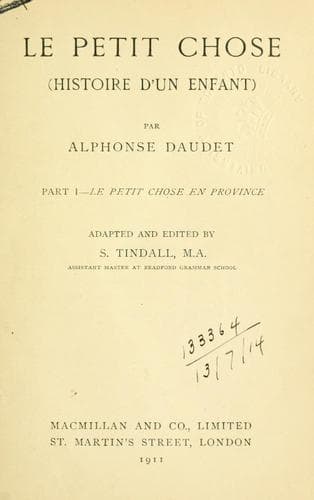
Le Petit Chose (Histoire d'un Enfant)Daudet, Alphonse
General
Le Petit Chose (Histoire d'un Enfant)
Daudet, Alphonse
Autobiographical fiction; Bildungsromans; French fiction -- 19th century; French language -- Readers
When I think over my own expensive education, I can see quite clearly that
the years which came between my departure from the school-room at home
and the time I got into the top form at school were elaborately wasted.
My time was mainly taken up with grammar, endless Latin proses, and
verses that were not poetry; none of which exercises did me the slightest
good. I forgot the grammar as soon as I conveniently could; I could never
do Latin prose till I had read great chunks of Latin authors, or verses
till I had studied the poets; and these accomplishments came to me by
imitation and not by rules. Mean-while my imagination was simply starved.
And yet there is so much in English literature to stimulate the imagination
of children!—I know that from my pre-school experience; and I believe
nearly all children have some imagination to start with, before it is
smothered under the verbs in -μι. Fortunately I was not a conscientious
or hard-working boy, and so I escaped the mental paralysis which
overtook some of my worthier companions.—From G. F. BRADLY’S _Dick_.
II
Daudet is naturally an optimist, and that spontaneous optimism is his
distinctive mark among all the novelists of the contemporary school.
There are characters in his works quite as depraved as those in Flaubert
and in Zola. But from the way in which he describes them one feels that
he despises their ignominy, and that he is indignant at their baseness.
Now the pessimist, in whose eyes baseness and ignominy are the very
essence of man, is no longer capable of indignation or contempt.
Nearly always Daudet’s books present to us, if only incidentally,
some favourite character which does credit to humanity. Out-and-out
pessimists accuse him of distorting human nature by attributing to it
imaginary graces and virtues: but does not their unbending pessimism
distort it in another direction by showing to us, under the pretext of
being truthful, only its meannesses and its horrors?—From PELLISSIER,
_Le Mouvement littéraire au XIXe siècle_.
III
Public-domain text, read in full here on John Shaqi.
Reviews
Reviews
No reviews yet
Be the first to share your thoughts on this work.
Elsewhere in the archive
Join the Discussion
Join the discussion
Sign in to leave a comment or review.
Sign InorCreate an account