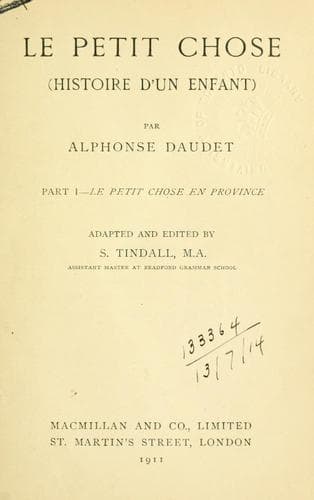
Le Petit Chose (Histoire d'un Enfant)Daudet, Alphonse
General
Le Petit Chose (Histoire d'un Enfant)
Daudet, Alphonse
Autobiographical fiction; Bildungsromans; French fiction -- 19th century; French language -- Readers
Ah! chère madame Eyssette! comme j’aurais voulu vous emporter ce soir-là,
comme j’aurais voulu vous arracher à cette impitoyable vache à lait,
et à son épouse; mais, hélas! je m’en allais au hasard moi-même,
ayant juste de quoi payer ma route, et je pensais bien que la chambre
de Jacques n’était pas assez grande pour nous tenir tous les trois.
Encore si j’avais pu vous parler, vous embrasser à mon aise; mais non!
On ne nous laissa pas seuls une minute.… Rappelez-vous: tout de suite
après dîner l’oncle se remit à sa grammaire espagnole, la tante essuyait
son argenterie, et tous deux ils nous épiaient du coin de l’œil.…
L’heure du départ arriva, sans que nous eussions rien pu nous dire.
Aussi le petit Chose avait le cœur bien gros, quand il sortit de chez
l’oncle Baptiste; et en s’en allant, tout seul, dans l’ombre de la grande
avenue qui mène au chemin de fer, il se jura deux ou trois fois très
solennellement de se conduire désormais comme un homme et de ne plus
songer qu’à reconstruire le foyer.
NOTES
_Title_. Le Petit Chose, ‘Little What’s-his-name,’ or ‘Little
What-do-you-call-him’: so also _Monsieur Chose, Madame Chose_.
Page 1. (chapter i. full=i)
2. Languedoc: an old province of the south of France,
so called from the name given to the language of its
inhabitants, who used the word _oc_ as an affirmative,
and were said to speak the _langue d’oc_ as distinguished
from the dialect spoken north of the Loire, which
expressed the affirmative by _oïl_ and was called the
_langue d’oïl_.
5. Carmélites: nuns of the order of Mount Carmel.
Their congregation was introduced into France in 1452.
13. aussi: note the inversion. In sentences beginning with
_aussi,_ ‘therefore,’ ‘so’; _à peine_, ‘hardly’;
_peut-être_, ‘perhaps’; _toujours,_ ‘still’; _au moins_,
‘at least’; _encore_, ‘yet,’ ‘even then,’ and a few more,
the _interrogative_ form of the verb is used.
Page 2.
7. Marseille, ‘Marseilles,’ Note the difference in spelling.
So also _Lyon_ (p. 9 l. 8.)
qui lui emportait plus de quarante mile francs, ‘who
robbed him of more than 40,000 francs.’ Why not _plus que_?
13. la grève des ourdisseuses, ‘the strike of the warping-women.’
_La grève_, originally=‘the strand,’ ‘beach.’
_La Place de Grève_, situated on the banks of the Seine,
was the Tyburn of ancient Paris. It was also in olden times
the rendezvous for the unemployed, hence the meaning ‘strike.’
Cf. _se mettre en grève, faire grève, les grévistes_.
16. la Révolution: i.e. the Revolution of February 24, 1848,
which caused Louis-Philippe, ‘king of the French,’ to
abdicate and a republic to be proclaimed.
Public-domain text, read in full here on John Shaqi.
Reviews
Reviews
No reviews yet
Be the first to share your thoughts on this work.
Elsewhere in the archive
Join the Discussion
Join the discussion
Sign in to leave a comment or review.
Sign InorCreate an account