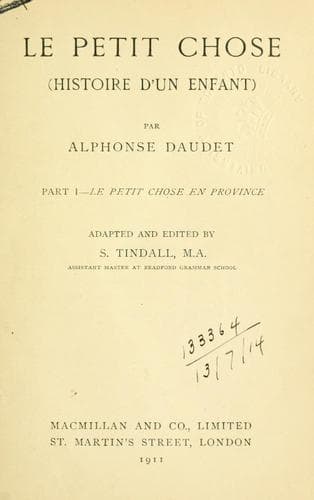
Le Petit Chose (Histoire d'un Enfant)Daudet, Alphonse
General
Le Petit Chose (Histoire d'un Enfant)
Daudet, Alphonse
Autobiographical fiction; Bildungsromans; French fiction -- 19th century; French language -- Readers
2. les yeux rouges et la joue ruisselante: note the absence
of a preposition corresponding to the English ‘with.’
It is a very characteristic French idiom.
12. que veux-tu, mon ami? ‘how can we help it, my dear?’
lit. ‘what would you have (him do)?’
16. qu’avait cet étrange garçon: inversion frequently occurs
in relative clauses, especially when the subject is
longer than the verb.
18. désolation, ‘distress’; désolé, ‘grieved,’ ‘disconsolate,’
_not_ ‘desolate.’
19. c’est pour le coup . . à son aise, ‘this was a grand
opportunity for him to sob to his heart’s content.’
31. une douzaine d’années: the suffix _-aine_ added to
numerals generally implies an approximate number;
_une quinzaine_, ‘about fifteen.’
Page 6.
5. mon fidèle Vendredi: Robinson Crusoe’s servant and companion.
12. je le jouais, ‘I acted it.’
21. tenait son emploi, ‘played his part.’
24. toujours est-il que, ‘anyhow.’ Cf. note, p. 1 l. 13.
28. j’en avais quelquefois le cœur bouleversé, ‘my courage was
sometimes shaken.’
Page 7.
1. gros mots d’enfants de la rue, ‘coarse expressions of the
street arabs.’
3. en pleine table, ‘before the whole table.’ Cf.—
p. 25 l. 11, _en pleine montagne_, ‘right on the hill
side, ‘in the heart of the mountains.’
p. 64 l. 20, _en pleine révolte_, ‘in open mutiny.’
p. 65 l. 30, _en pleine étude_, ‘before the whole class.’
So also—
_en plein air_, ‘in the open air.’
_en pleine rue_, ‘in the middle of the street.’
_en plein hiver_, ‘in the depths of winter.’
11. ukase: a Russian term for an ‘edict’ or imperial order.
13. loge, ‘porter’s lodge.’
du côté de, ‘somewhere about,’ ‘in the direction of.’
Note this use of _de_ of motion ‘towards,’ and cf. _de
mon côté_ (p. 8. l. 12), _du côté de sa chère fabrique_
(p. 10 l. 6), etc. Don’t confuse with _à côté de_;
see note, p. 11 l. 3.
26. se dégoûta de, ‘became tired of.’
28. au fond de, ‘in the remotest parts of.’ Note _il sait
l’anglais a fond_, ‘he knows English thoroughly.’
Page 8.
10. de bonne heure, ‘early’; _à la bonne heure_, ‘all right,’
‘well done,’ ‘capital!’ Like _par exemple_ (see note,
p. 3 l. 22), the latter derives its meaning from the
context or tone in which it is said. Note _sur l’heure_
(p. 78 l. 8), ‘immediately,’ ‘at once’; _tout à l’heure_,
‘a moment ago,’ ‘presently.’
14. juste Dieu! ‘good gracious!’ ‘gracious me!’ So also _grand Dieu_
(l. 29). These and similar exclamations, e.g. _mon Dieu!—ah!
mon Dieu!—mon Dieu, oui!_ must _not_ be translated literally.
There is no idea of profanity attached to them.
16. à plat ventre, ‘flat on my face.’
19. c’est égal, ‘all the same.’
30. il n’en fut rien, ‘nothing of the kind happened.’
Page 9.
Public-domain text, read in full here on John Shaqi.
Reviews
Reviews
No reviews yet
Be the first to share your thoughts on this work.
Elsewhere in the archive
Join the Discussion
Join the discussion
Sign in to leave a comment or review.
Sign InorCreate an account