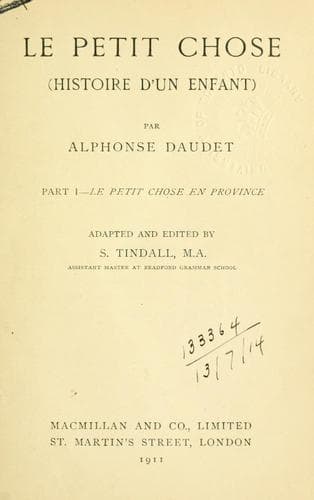
Le Petit Chose (Histoire d'un Enfant)Daudet, Alphonse
General
Le Petit Chose (Histoire d'un Enfant)
Daudet, Alphonse
Autobiographical fiction; Bildungsromans; French fiction -- 19th century; French language -- Readers
1. dès qu’ils furent partis, je courus: after _après que,
aussitôt que, dès que, à peine, quand, lorsque_,
the _Past Anterior_, not the _Pluperfect_, must be used
when the principal verb is in the preterite. In other
words, the auxiliary of the compound verb must be in the
same tense as the verb in the principal sentence.
22. il avait pris les devants, ‘he had gone on in front.’
26. Beaucaire: a fine town on the right bank of the Rhone.
It is connected with Tarascon by a splendid
suspension-bridge, and is famous for its fair held annually
in July, and frequented by many thousands of people.
Daudet gives a graphic account of it in _Numa Roumestan_.
Page 10.
2. Un parapluie: note the gender; nouns ending in _e_ mute
preceded by a vowel are usually feminine. Other
exceptions are _génie, incendie, lycée, musée_.
3. tout de même, ‘all the same.’
Page 11. (chapter ii. full=ii)
3. à côté de, ‘by the side of,’ ‘beside.’ Cf. note,
p. 7 l. 13. Distinguish also _à côté_ and _de côté_;
e.g. _il demeure à côté_, ‘he lives close by’; _la maison
d’à côté_ ‘the next house’; _le tableau est de côté_ ‘the
picture is on one side’; _un regard de côté_, ‘a side glance.’
7. large, ‘broad,’ _never_ ‘large.’
8. le ciel riait, ‘the sky was radiant.’
9. descendaient au fil de l’eau, ‘were going down stream.’
19. ma foi! ‘upon my word!’ ‘faith!’ _not_ ‘my faith!’
Never translate this expression literally.
Page 12.
3. serrés les uns contre les autres, ‘closely packed.’
9. à tâtons, ‘groping his way along.’
qui vive? ‘who goes there?’ The challenge of a French sentinel.
14. et en route, ‘and moved off.’
21. ah! mon Dieu! see note, p. 8 l. 14.
23. me serra plus fort, ‘grasped my hand more firmly.’
29. s’il parlait, je crois bien: on l’entendait d’une lieue,
‘I should rather think it was talking, you could hear it
a mile off.’ The sentence is elliptical, _vous demandez_
being understood before _s’il_. Note the idiomatic use
of _bien_, and cf. _je le veux bien_, ‘I am _perfectly_
willing’; _voulez-vous bien vous en aller_, ‘_won’t_ you go away!’
_je donnerais bien un franc_, ‘I shouldn’t mind giving a franc.’
30. trouble, ‘agitation,’ ‘confusion,’ _not_ ‘trouble,’
the French for which is _peine, chagrin, douleur.
Les troubles_=‘rebellion,’ ‘rising,’ e.g. _des troubles
éclatèrent en France_.
Page 13.
9. plus de Vendredi! plus de perroquet…plus possible: _plus_ is
often used negatively without _ne_ when the verb is understood.
Trans. ‘without a Friday, or a parrot, a Robinson would not
be possible any longer.’
10. le moyen: elliptical for _dites-moi le moyen_.
Trans. ‘how was it possible to…’ or ‘how could one…’
11. d’ailleurs, ‘besides’; _ailleurs_=‘elsewhere.’
13. rue Lanterne: note omission of preposition and article.
Public-domain text, read in full here on John Shaqi.
Reviews
Reviews
No reviews yet
Be the first to share your thoughts on this work.
Elsewhere in the archive
Join the Discussion
Join the discussion
Sign in to leave a comment or review.
Sign InorCreate an account