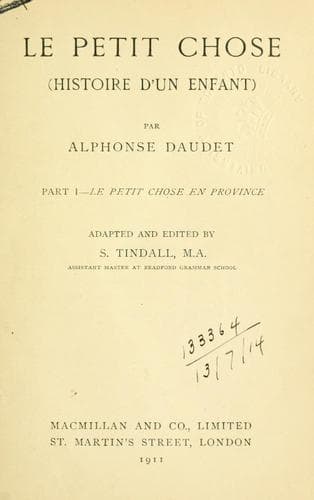
Le Petit Chose (Histoire d'un Enfant)Daudet, Alphonse
General
Le Petit Chose (Histoire d'un Enfant)
Daudet, Alphonse
Autobiographical fiction; Bildungsromans; French fiction -- 19th century; French language -- Readers
20. quatre à quatre, ‘four steps at a time,’ lit. ‘four by four.’
Cf. peu à peu (p. 40 l. 25); goutte à goutte (p. 83 l. 1).
21. séculaire, ‘ancient,’ lit. ‘centuries old.’ ‘Secular’ in
French is séculier.
28. cabaret: a small public-house where food and drink only
are supplied, not lodging, as in an auberge (p. 36 l. 9).
Page 26.
1. au compagnon du tour de France, ‘the Oddfellows’ Arms.’
A _compagnon_ was a workman affiliated to a ‘Trade Union’
(_compagnonnage_). As an emblem of their association the
_compagnons_ carried long canes with ribbons tied to them.
Note that in French, as in German, the dative is used in
the signs of inns, shops, etc.; e.g. _à la Toison d’or,
au Cerf-Volant, à la ville de Marseille; zum goldenen Löwen_.
2. voici mon affaire, ‘this is just what I want.’
13. un vieux coureur de tavernes, ‘an habitué of public-houses.’
19. miséricorde! ‘gracious me!’
22. eh! mon Dieu, oui, ‘yes indeed.’
23. anciennement, ‘formerly.’ Cf. note, p. 28 l. 31.
Page 27.
12. justice divine! see note, p. 8 l. 14.
17. mouillettes: long narrow pieces of bread to dip into wine
or boiled eggs.
19. Un vieux Château-Neuf-des-Papes: a famous wine, so called
from the name of a vineyard near Avignon.
25. va trinquer, ‘is going to have a friendly glass with us.’
_Trinquer_, ‘to touch glasses,’ a continental fashion when
drinking some one’s health. Cf. German _trinken_, and
English to ‘clink’ glasses.
29. à quoi encore? ‘and what next?’
Page 28.
9. enfin, ‘still,’ ‘however.’
21. que voulez-vous? see notes, p. 5 l. 12 and p. 20 l. 18.
31. ancien, ‘former.’ Cf. _quelques anciens_ (p. 63 l. 14),
‘a few old boys (of the school).’ So _un nouveau_
(p. 30 l. 21), ‘a new boy.’
Page 29.
1. à toutes jambes, ‘as fast as he could.’
7. bout: trans. ‘vestige.’ Note—
_un bout d’homme_, ‘a little bit of a man.’
_un bout de conversation_, ‘a short chat.’
_un bout de papier_, ‘a scrap of paper.’
_un bout de lettre_, ‘a line.’
8. qui dépasse, ‘overhanging.’
plus . . plus: see note, p. 13 l. 9.
(chapter iv. full=v)
17. que la montagne enserre de partout, ‘which is closed in on
all sides by the mountains.’
21. tramontane, ‘north wind. A term used along the French
Mediterranean. It comes from the Italian _tramontana_,
‘on the other side the Alps.’
25. place d’armes, ‘parade-ground.’
Page 30.
3. impériale, ‘seat behind the driver.’ The stage-coach of
olden times in France was divided into four
compartments—(1) _le coupé_ ‘the seat facing the
horses,’ and hence the most expensive; (2) _l’intérieur_,
the seat inside’; (3) _la rotonde_, ‘the back seat’;
(4) _l’impériale_, a word now used for the top of an
omnibus or tramway.
29. pour le quart d’heure, ‘at present,’ just now.’
Public-domain text, read in full here on John Shaqi.
Reviews
Reviews
No reviews yet
Be the first to share your thoughts on this work.
Elsewhere in the archive
Join the Discussion
Join the discussion
Sign in to leave a comment or review.
Sign InorCreate an account