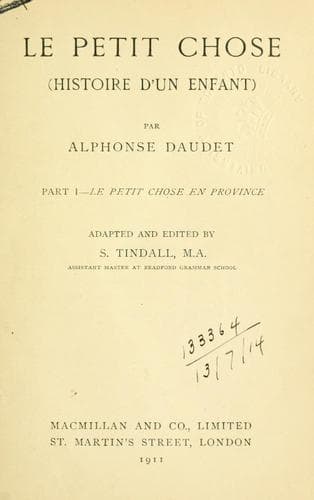
Le Petit Chose (Histoire d'un Enfant)Daudet, Alphonse
General
Le Petit Chose (Histoire d'un Enfant)
Daudet, Alphonse
Autobiographical fiction; Bildungsromans; French fiction -- 19th century; French language -- Readers
23. achevait sa philosophie, ‘was finishing his course of
philosophy,’ i.e. was completing his school education.
The order of the forms in a French school, beginning with the
lowest, is _neuvième, huitième, septième, sixième, cinquième,
quatrième, troisième, seconde, première, philosophie_.
29. Eyssette père, ‘Eyssette senior’ so _Eyssette fils_
(p. 24 l. 21), ‘Eyssette junior.’
Page 22.
20. un parti à prendre, ‘one decision to come to.’ Note
_prendre son parti_, ‘to make up one’s mind’; _épouser un
bon parti_, ‘to make a good match’; _tirer parti de_, ‘to
turn to account.’ Distinguish carefully from _la part_,
‘share,’ and _la partie_, ‘part,’ ‘portion,’ ‘game,’ etc.
22. de notre côté, ‘for ourselves.’ Cf. note, p. 7 l. 13.
28. jusqu’à nouvel ordre, ‘until matters improve.’
31. comme commis-voyageur à la société vinicole, ‘as a
commercial traveller for the wine-growers’ society.’
Page 23.
3. justement je reçois, ‘it just happens that I have received.’
4. maître d’étude, ‘usher.’
10. c’est bien, ‘very well.’
19. qu’on s’occupe de sa malle, ‘let some one see to his trunk
being packed.’
23. fait au . ., ‘accustomed to . .’
28. Eyesette: names of persons or families are _invariable_
in the plural, e.g. _les Corneille et les Racine_,
except certain well-known historical names, chiefly of
dynasties, e.g. _les Césars, les Tudors, les Bourbons_.
But when used as common nouns to denote ‘persons like’ or
‘works by’ those named, they are variable. In the latter
case, however, they only take the mark of the plural,
according to some grammarians, when speaking of different
editions, not of several copies of the same edition.
Page 24.
17. Académie: see note, p. 16 l. 15.
20. n’ayant rien qui sentît le pédant, ‘having nothing about
him which savoured of the pedant.’ Cf. note, p. 17 l. 20.
Why is _sentît_ subjunctive?
23. brave: note _un brave homme_, ‘a good, honest man’;
_un homme brave_, ‘a brave, courageous man.’
25. ah! mon Dieu! ‘why!’ Cf. note, p. 8 l. 14.
27. mauviette, ‘delicate’; _une mauviette_, lit. ‘a lark.’
Page 25.
6. mais enfin, ‘however.’
9. baraque: slang for ‘school.’
10. collège communal, ‘communal’ or ‘municipal school.’
Distinguish carefully between a lycée and a collège.
The former is kept up entirely by the State; the latter
partly by the State, partly by the town. Both provide
‘secondary’ education.
11. Sarlande: a fictitious name. Alais was the place where
Daudet really went.
en pleine montagne: see note, p. 7 l. 3. Alais is near
the Cévennes mountains.
16. la lettre terminée: this construction of a noun or pronoun
with a participle, standing independently of any other
word in the sentence, and representing a subordinate
clause, is very common in French. It is the exact
equivalent of the ablative absolute in Latin.
Public-domain text, read in full here on John Shaqi.
Reviews
Reviews
No reviews yet
Be the first to share your thoughts on this work.
Elsewhere in the archive
Join the Discussion
Join the discussion
Sign in to leave a comment or review.
Sign InorCreate an account