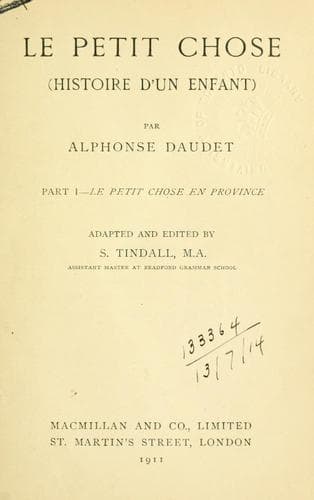
Le Petit Chose (Histoire d'un Enfant)Daudet, Alphonse
General
Le Petit Chose (Histoire d'un Enfant)
Daudet, Alphonse
Autobiographical fiction; Bildungsromans; French fiction -- 19th century; French language -- Readers
5. appointements, ‘salaries.’ _Traitement_ is generally used
for the salary of civil servants and professional men.
17. ou bien, ‘or else.’
Page 38.
3. un original, ‘an eccentric fellow.’
21. parbleu! c’est bien le cas de dire . . ‘by Jove! one may indeed
say . .’
25. en rit: _rire_ and _sourire_ with _à_ imply greeting,
with _de_ derision.
28. pour avoir seulement quelques pouces de plus,
‘to have been so much as a few inches taller.’
30. ça ne fait rien, ‘never mind,’ ‘no matter.’
31. pour passer sous la même toise, ‘to be measured by the
same standard.’ _Toise_, ‘fathom,’ an old length measure
about 6 ft. 5 in., used for measuring the height of conscripts.
Page 39.
3. Je paye un punch d’adieu, ‘I’ll pay for a farewell glass
of punch.’ _Punch_, from an Indian word meaning ‘five,’
so called from its five ingredients, viz. spirit, water,
lemon, sugar and spice. It is also called
‘contradiction,’ because it is composed of spirit to make
it strong, water to make it weak, lemon juice to make it
sour, and sugar to make it sweet.
4. je veux que vous en soyez: cf. _êtes-vous des nôtres?_
‘are you one of our party?’ or ‘won’t you join us?’
14. le ban et l’arrière-ban des habitués, ‘the whole body of
the frequenters.’ The _ban_ in the Middle Ages=the
immediate vassals of the king, i.e. those under his _banner_;
the _arrière-ban_=the reserve force, composed of older citizens,
who did not take up arms except in moments of peril.
17. à dire vrai, ‘to tell the truth.’ Cf. _à tout prendre_,
‘upon the whole’; _à bien regarder_, ‘on close consideration.’
28. en somme, vous êtes bien tombé, ‘on the whole you have
fallen on your feet.’
29. absinthe: a plant having a somewhat strong smell and
bitter taste. It is used for medicinal purposes, and
also for the preparation of the liqueur known as ‘absinthe.’
30. à la boîte: cf. _baraque_, p. 25 l. 9.
31. vous ne serez pas trop mal, ‘you will not be too badly off.’
Page 40.
2. l’étude des petits, ‘the junior school.’ So _l’étude des
moyens_ (p. 51 l. 5), ‘the middle school.’
3. qu’on mène à la baguette, ‘that you can rule with a rod of iron.’
4. méchant. Note—
_un méchant homme_, ‘a bad _or_ wicked man.’
_un homme méchant_, ‘a mischievous _or_ spiteful man.’
Cf. note, p. 24 l. 23.
6. père Viot, ‘old Viot.’
11. les fonctions d’économe, ‘the duties of a bursar.’
15. fée, ‘old hag’ or ‘old witch.’
24. confidences, ‘secrets.’
27. parlant haut: see note, p. 17 l. 16.
Page 41.
6. ce que c’est que de nous, pourtant! ‘and yet, what weak
creatures we are!’
7. un file de famille en rupture de ban, ‘a youth of good family,
who had gone the pace a bit’; lit. ‘escaped from banishment.’
11. d’un meilleur œil, ‘more favourably.’
Page 42.
13. troublé, ‘disturbed in mind.’ Cf. note, p. 12 l. 30.
Public-domain text, read in full here on John Shaqi.
Reviews
Reviews
No reviews yet
Be the first to share your thoughts on this work.
Elsewhere in the archive
Join the Discussion
Join the discussion
Sign in to leave a comment or review.
Sign InorCreate an account