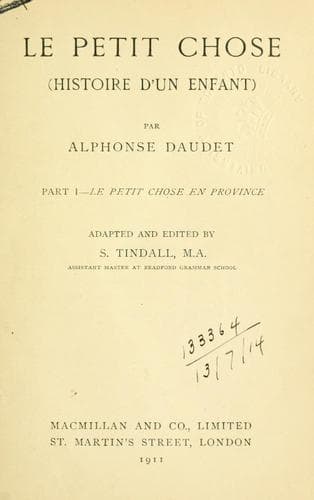
Le Petit Chose (Histoire d'un Enfant)Daudet, Alphonse
General
Le Petit Chose (Histoire d'un Enfant)
Daudet, Alphonse
Autobiographical fiction; Bildungsromans; French fiction -- 19th century; French language -- Readers
30. bibliothèque, ‘library’; _librairie_, ‘bookseller’s shop _or_ trade.’
So _bibliothécaire_, ‘librarian’; _libraire_, ‘bookseller.’
Page 54.
1. tenir, ‘to keep in stock.’
5. diable d’homme, ‘terrible man.’ Note—
_un bon diable_, ‘a good fellow.’
_c’est là le diable_, ‘that’s the trouble.’
_cela ne vaut pas le diable_, ‘that is not worth anything.’
10. voix de Titan, ‘Titanic voice.’ The Titans in ancient
mythology were gigantic beings, representing the
primitive powers of Nature.
17. brûle-gueule, ‘cutty.’
21. le tranchant de sa voix, ‘his peremptory voice.’
22. tapissée de, ‘lined with.’
25. tant bien que mal, ‘as well as I could.’
Page 55.
2. les Condillac: the plural would be preferable. See note,
p. 23 l. 28.
4. tu ne veux pas? . . à ton aise, ‘you don’t care about
smoking?… well! just as you like.’ Note—
_être à son aise_, ‘to be in easy circumstances.’
_ne pas se sentir à son aise_, ‘to feel uncomfortable.’
6. surtout ne le gâte pas, ‘but be very careful and don’t
spoil it.’
10. tu t’occupes donc de philosophie? ‘so you are busy reading
philosophy, are you?’
12. par hasard, ‘I wonder.’ A sarcastic colloquialism.
des histoires, mon cher, de pures histoires! ‘fables,
my dear boy, nothing but fables!’
14. je vous demande un peu! ‘just think of it!’
16. pendant qu’ils y étaient, ‘whilst they were at it.’
18. ah! misère de moi! ‘ah me!’
31. à propos, ‘by the bye.’ Note—
_il est venu fort à propos_, ‘he came very opportunely.’
_à propos de_, ‘with regard to.’
_de propos délibéré_, ‘on purpose.’
Page 56.
1. le bon Dieu: do not translate _le bon_. Cf. the German
_der_ liebe _Gott_.
2. sans quoi tu ne t’en tireras jamais, ‘or else you will
never get over your troubles.’
7. j’ai passé par là, ‘I have been through it all.’ Cf.—
_il faut bien que j’en passe par là_, ‘I must put up with it.’
9. monsieur l’abbé: simply ‘sir.’
19. le plus souvent, ‘more often than not.’
23. pattes de mouche, ‘scrawl.’
30. seulement, ‘even,’ ‘so much as.’ A quite common and classical
use of this word.
Page 57.
5. il était temps; je n’y pouvais plus tenir, ‘it was high time,
I could stand it no longer.’
10. au fond, ‘at the far end.’ Cf. note, p. 7 l. 28.
20. en serre-file, ‘bringing up the rear.’
21. le professeur de seconde, ‘the second-form master. He would
correspond to a fifth-form master in an English school.
Cf. note, p. 21 l. 23.
30. la tête: note (1) the number, (2) the use of the definite article.
31. foulards ponceau, ‘flame-coloured silk handkerchiefs.’
Nouns serving as adjectives of colour are generally invariable.
Page 58.
6. ne les laissait pas chômer, ‘did not allow them any rest’:
_chômer_=‘to be out of work,’ _chômage_, ‘want of work.’
‘Unemployment’ would be the best word were it English.
10. tohu-bohu: an onomatopoeia.
Public-domain text, read in full here on John Shaqi.
Reviews
Reviews
No reviews yet
Be the first to share your thoughts on this work.
Elsewhere in the archive
Join the Discussion
Join the discussion
Sign in to leave a comment or review.
Sign InorCreate an account