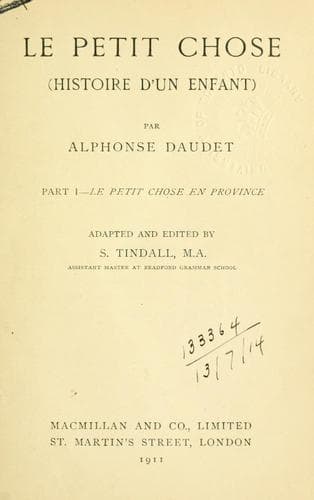
Le Petit Chose (Histoire d'un Enfant)Daudet, Alphonse
General
Le Petit Chose (Histoire d'un Enfant)
Daudet, Alphonse
Autobiographical fiction; Bildungsromans; French fiction -- 19th century; French language -- Readers
13. de près, ‘close to.’
18. miséricorde! ‘good gracious!’
Page 78.
1. je ne voulais pas répondre, ‘I was determined not to reply.’
8. sur l’heure: see note, p. 8 l. 10.
15. d’un trait, lit. ‘at a stretch,’ i.e. ‘without stopping.’
Page 79.
3. noble cœur, ‘fine fellow.’
8. me serrant les poignets à les briser: see note, p. 70 l. 11.
9. je ne vous dis que ça, ‘that is all I have to say.’
Page 80.
2. j’étais au service, ‘I was in the army.’ _Être au
service_ is used only of military service. Distinguish
from _être de service_, ‘to be on duty,’ ‘be in
attendance’; _se mettre en service_, ‘to go into service.’
3. par un coup de ma mauvaise tête, ‘by any quick-tempered act of mine.’
17. être à même de, ‘to be in a position to,’ ‘be able to.’
20. c’était bien le moins qu’on attendit, ‘the least one could do
was to wait.’
27. ce que c’est que de nous! see note, p. 41 l. 6.
Page 81.
12. de quoi: cf.—
_j’ai de quoi payer le voyage_, ‘I have enough to pay for
the journey.’
_il n’y a pas de quoi rire_, ‘it is no laughing matter.’
_il n’y a pas de quoi!_ ‘don’t mention it!’
19. le moyen de: see note, p. 13 l. 10.
Page 82.
1. je pardonnai les arrêts des élèves, ‘I let the boys off detention.’
10. que diable pouvaient-ils faire? ‘whatever could they be doing?’
(chapter x. full=xii)
18. du train dont j’allais, ‘judging from the rate at which I
was walking’; cf.—
_à fond de train_ ‘at full speed.’
_il nous a menés bon train_, ‘he brought us along at a great rate.’
je dus faire le trajet, ‘I must have covered the ground.’
Page 83.
10. le coup de l’étrier, ‘the stirrup-cup.’ A glass of liquor given
in the Highlands to a guest on leaving, when his feet are
already in the stirrups. It is sometimes called the ‘parting cup,’
or in the north of the Highlands ‘the cup at the door.’
12. et me voilà courant, ‘and I started to run.’
à perdre haleine: see note, p. 99 l. 12.
15. pourvu que: see note, p. 15 l. 30.
17. conduisit: remember that to ‘take’ a person somewhere is _conduire_
or _mener_, not _prendre_.
19. louche, ‘of doubtful reputation.’
Page 84.
8. à faire pleurer: see note, p. 70 l. 11.
11. la ripaille devait chauffer, ‘the revelry must have reached
its climax.’
12. toutes grandes, ‘quite wide.’ When is the adverb _tout_ variable?
19. riaient à se tordre, ‘were splitting with laughter’;
see note, p. 70 l. 11.
25. fort à propos: see note, p. 55 l. 31.
Page 85.
14. devaient être, ‘must have been.’
15. auditoire, ‘audience’; the French _audience_=‘official reception,’
e.g. _le roi lui a donné audience_.
18. des zouaves: the Zouaves are a body of French infantry serving
in Algeria. They are famous for their fearless courage.
19. la partie perdue, ‘the game was up.’
Public-domain text, read in full here on John Shaqi.
Reviews
Reviews
No reviews yet
Be the first to share your thoughts on this work.
Elsewhere in the archive
Join the Discussion
Join the discussion
Sign in to leave a comment or review.
Sign InorCreate an account