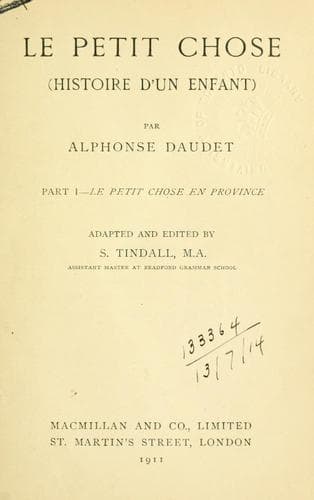
Le Petit Chose (Histoire d'un Enfant)Daudet, Alphonse
General
Le Petit Chose (Histoire d'un Enfant)
Daudet, Alphonse
Autobiographical fiction; Bildungsromans; French fiction -- 19th century; French language -- Readers
8. l’air de cette Bastille ne te vaut rien, ‘the air of this prison
is not good for you.’ The Bastille, the famous State prison
in Paris, was stormed on July 14, 1789, by the Revolutionists
and razed to the ground.
Page 95.
9. ma place à retenir, ‘my seat to book.’
(chapter xi. full=xiii)
23. à grandes enjambées: cf. _à grands pas_. What does the suffix
_-ée_ denote?
Page 96.
13. de ce pas, ‘immediately,’ ‘at once.’
19. à pleines mains: cf. note, p. 49 l. 22.
22. un coup de théâtre: an event which is quite unforeseen by
the audience and alters the whole course of a play.
See note, p. 2 l. 17.
Page 97.
2. j’étais ferré à glace sur . ., ‘I was quite an expert in . .’:
_ferré à glace_, lit. ‘rough-shod.’ Cf.—
_il est ferré sur la géographie_, ‘he is well up in geography.
11. bureau des messageries, ‘coach-office.’
16. étaient au complet, ‘were all present.’
23. sur l’oreille, ‘on one side.’
Page 98.
1. net: see note, p. 17 l. 16.
6. flambant, ‘overbearing.’
11. va! ‘I tell you!’ ‘Va!’ like ‘_allez!_’ is often used emphatically,
with the meaning of ‘I can tell you!’ ‘indeed!’ ‘take my word for
it!’ ‘depend on it!’
Page 99.
4. délices: this word is masculine in the singular and feminine
in the plural. Cf. _amour_ and _orgue_.
12. d’une haleine: lit. ‘in one breath,’ i.e. ‘without stopping to
take breath.’ Cf.—
_j’ai couru à perte d’haleine_, ‘I ran until I was out of breath.’
Page 100.
15. fais feu de tes quatre roues, ‘rattle along.’
18. et qu’ensuite il mette le cap sur Paris, ‘and then steer for Paris.’
A naval expression.
(chapter xii. full=xiv)
22. que: emphatic. See note, p. 4 l. 31.
24. à un grand gendarme de femme, ‘to a big masterful woman.’
Page 101.
25. convaincu, ‘confident.’
Page 102.
3. ne devait pas être, ‘was not likely to be,’ ‘could not be.’
7. avait l’air gênée, ‘seemed very uneasy.’ With the expression
_avoir l’air_ the adjective may agree indifferently with the
subject or with _air_ when it refers to either; but if it cannot
refer to one of them it must agree with the other, e.g. _cette
pomme a l’air mûre_, not _mûr_, because the air cannot be ripe.
14. joli, le dîner! ‘a fine dinner it was, too!’
Page 103.
3. vieilles gens: attributive adjectives are generally _feminine_
when preceding and _masculine_ when following _gens_.
7. lui coupe l’appétit, ‘has taken away her appetite.’
13. de quoi payer: cf. note, p. 81 l. 12.
15. encore si . ., ‘if only . .’
16. à mon aise: cf. note, p. 55 l. 4.
23. avait le cœur gros, ‘felt a sinking at the heart,’ ‘felt sad
and oppressed.’
APPENDICES
BY
THE GENERAL EDITORS
APPENDIX I.—WORDS AND PHRASES FOR _VIVA VOCE_ DRILL
II.—QUESTIONNAIRE
III.—SENTENCES ON SYNTAX AND IDIOMS FOR _VIVA VOCE_ PRACTICE
IV.—PASSAGES FOR TRANSLATION INTO FRENCH
V.—SUJETS DE RÉDACTION
I. WORDS AND PHRASES
Public-domain text, read in full here on John Shaqi.
Reviews
Reviews
No reviews yet
Be the first to share your thoughts on this work.
Elsewhere in the archive
Join the Discussion
Join the discussion
Sign in to leave a comment or review.
Sign InorCreate an account