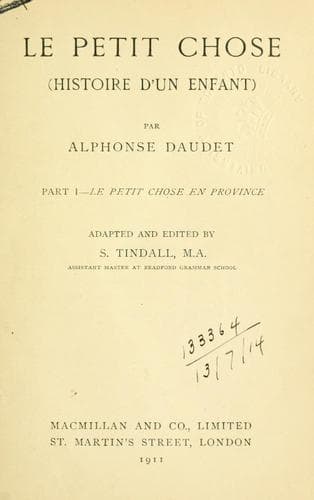
Le Petit Chose (Histoire d'un Enfant)Daudet, Alphonse
General
Le Petit Chose (Histoire d'un Enfant)
Daudet, Alphonse
Autobiographical fiction; Bildungsromans; French fiction -- 19th century; French language -- Readers
1. My neighbour was a youth of good family who had gone the pace a bit.
2. Everything was so silent that you might have thought the house was
empty.
3. Come to me as soon as you have done.
4. And thus it was that I began my new career.
5. My boys were as yet untouched by the atmosphere of the school.
6. Even in winter the windows were always wide open.
7. It is for you especially (_use the word “intention”_) that
I have composed this little tale.
8. Remember that I do not want you to speak in this way.
9. The narrator stopped short with one hand in the air.
10. Do you not miss your friend a good deal?
11. The college was divided into three departments: the Senior School,
the Middle School and the Junior School.
12. As for him, he might smile at me as much as he liked, I could not
like him.
13. When you see them, tell them I owe them no grudge.
14. As soon as he was in, he double-locked the door.
15. Twice a week we went to that spot, half a league from the town.
X (pp. 51—55)
1. Usually on those occasions I had the whole college on my hands.
2. Most of them used to fall into step splendidly.
3. It was in vain I spoke to him, he refused to listen to me.
4. The poor fellow was ridiculously short, badly dressed, redolent
of the gutter, and, to crown all, dreadfully bandy-legged.
5. We always had at our heels a swarm of ragamuffins turning
cart-wheels behind us.
6. The little imp was smiling as if nothing were the matter.
7. The whole division began to go off at a frightful pace.
8. He was the son of a farrier, who was working himself to death
for his education.
9. We have been waiting for you for more than twenty minutes.
10. I often looked at him, putting out his tongue and leaning on
his pen with all his might.
11. As soon as he had finished his work, he used to go out.
12. On that day he went out as soon as he had finished his work.
13. The grotto was so low that we were obliged to go in on all fours.
14. I wonder whether I shall ever succeed in teaching him anything.
15. Do you know what has become of my letter?
XI (pp. 51—55)
Public-domain text, read in full here on John Shaqi.
Reviews
Reviews
No reviews yet
Be the first to share your thoughts on this work.
Elsewhere in the archive
Join the Discussion
Join the discussion
Sign in to leave a comment or review.
Sign InorCreate an account