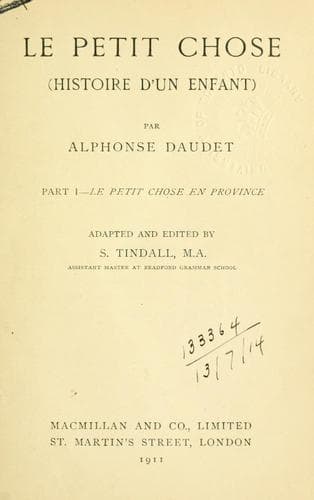
Le Petit Chose (Histoire d'un Enfant)Daudet, Alphonse
General
Le Petit Chose (Histoire d'un Enfant)
Daudet, Alphonse
Autobiographical fiction; Bildungsromans; French fiction -- 19th century; French language -- Readers
1. I should pity him more if he did not complain so often.
2. Although it was spring, a good deal of snow had fallen during the night
3. Even if (_do not use ‘si’_) they had utterly demolished the house I
should not have noticed it.
4. I was far from suspecting that they had been in England for the last
fortnight.
5. Taking everything into account, I hope I shall be able to send you
something from time to time out of my savings.
6. What a beautiful town Paris is!
7. Here at any rate it is not always foggy as in Lyons.
8. I had come to that part of the letter when I suddenly heard a
dull noise.
9. In the playground the children were shouting at the top of their
voices.
10. Why do you not want us to mention it to them?
11. A monotonous plain stretched as far as the eye could see.
12. I was longing to be alone in my room.
13. We have not seen them yet, but they will not be long in coming.
14. I began to go up the stairs four steps at a time.
15. The new secretary was beside himself with joy.
XVI (pp. 76—80)
1. Before going in, I stopped an instant to recover my breath.
2. The head master in his dressing-gown was standing near him, with
his velvet cap in his hand.
3. I did not know what it was all about, but on hearing these words
I blushed for shame.
4. Turning to me, he took from the mantel-piece a little bundle of papers
I had not yet noticed.
5. Instead of answering him, he hung down his head and remained silent.
6. One word might have exculpated me, but that word I did not utter.
7. I was ready to suffer anything rather than betray my friend.
8. It is half-past ten already; they must have missed the train.
9. All my courage suddenly failed me, and, without saying a word, I
hurriedly went out.
10. I saw his face brighten as I spoke.
11. “Listen to this before I go,” said he in a low voice.
12. You must promise me to write to them when everything is over.
13. When I was in the army, I vowed that, if ever I came to be drummed out,
I would not survive my dishonour.
14. I would rather lose my situation than be the cause of his death.
15. The very least we can do is to wait till the last moment before coming
to such a decision.
XVII (pp. 81—85)
Public-domain text, read in full here on John Shaqi.
Reviews
Reviews
No reviews yet
Be the first to share your thoughts on this work.
Elsewhere in the archive
Join the Discussion
Join the discussion
Sign in to leave a comment or review.
Sign InorCreate an account