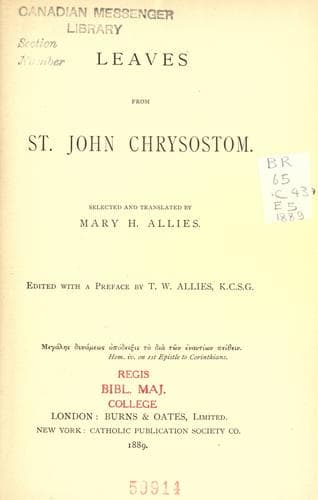
Leaves from St. John ChrysostomJohn Chrysostom, Saint
Religion
Leaves from St. John Chrysostom
John Chrysostom, Saint
Christian literature, Early; John Chrysostom, Saint, -407
they, and the more so as he incurs greater necessities than they, which
may sully his purity, unless by constant watchfulness and strenuous
effort he makes his soul inaccessible to their influence. Thus, there
are fair faces, and luxurious movements, and a studied walk, and a
mincing tone of voice, and painted eyes, and rouged cheeks, beautiful
plaits, dyed hair, rich clothes, variegated golden ornaments, fine
precious stones, the perfume of scents, and all other things of the
kind, dear to the female sex, which are calculated to upset a soul that
is not armed in the austerity of wisdom. It is no wonder if a man be
troubled by _these_ things; but that the devil should be able by the
contrary things to wage war against the souls of men and to wound
them,—_this_ is most surprising and embarrassing. Already some who have
escaped the former snares have allowed themselves to be taken by that
which was so different. For an unstudied address, neglected hair, a
dirty garment, a disordered appearance, a careless demeanour, a natural
manner, frank language, an unartificial gait, an artless voice, a life
of poverty, the being despised, and unprotected, and in solitude, have
inspired a man at first with pity, and from that have led him to utter
destruction. And many who have escaped the former snares, the snares of
gold, and perfume, and clothes, and the rest which go with them, as I
said, have fallen into these so far removed from those, and have been
lost. Now, when the battle strikes on the spectator’s soul, and weapons
of war surround him on all sides, whether by poverty or by riches, by
adornment or by simplicity, by a studied manner or by unaffectedness, or
in any other of the ways which I have enumerated, whence is refreshment
to come to him who is thus hemmed in? How are we to meet the case, not
of being taken by force, for this is not so very difficult, but of
keeping our mind in tranquillity from impure thoughts? I pass over
honours, which are the causes of a thousand evils. Those which come from
women lower the tone of the tempered mind, and often work ruin whenever
a man is not wholly on his guard against such plottings. And as to
honours coming from men; if they be not received with much
high-mindedness, they involve a man in two opposite sufferings—the
slavishness of flattery and the foolishness of boasting. On the one
hand, he is forced to stoop to those who serve him; on the other, he is
puffed up against his inferiors through these honours of theirs, and
thrust into an abyss of folly. _We_ say this, but the harm of it can
only be properly ascertained by experience. And, necessarily, things
much worse and more dangerous than these would happen to those who are
in the midst of the fight. The lover of the desert is exempted from all
this, for if a foolish thought _did_ suggest something of the kind to
him, this imagination is weak and easily overcome, because the flame of
the eyes is not fed by outward things. Now the monk fears for himself
Public-domain text, read in full here on John Shaqi.
Reviews
Reviews
No reviews yet
Be the first to share your thoughts on this work.
Elsewhere in the archive
Join the Discussion
Join the discussion
Sign in to leave a comment or review.
Sign InorCreate an account