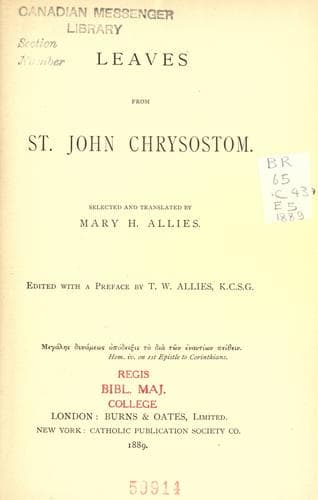
Leaves from St. John ChrysostomJohn Chrysostom, Saint
Religion
Leaves from St. John Chrysostom
John Chrysostom, Saint
Christian literature, Early; John Chrysostom, Saint, -407
sufficient for those who are here present, if they will lay it to heart.
Let us always be mindful of these words, beloved brethren, and of the
holy kiss of peace, and of the most sacred embrace which we give to each
other. For this it is which holds our minds together, and makes us all
one body, since we all partake of one Body. Let us then blend ourselves
into one body, not mixing our bodies, but uniting our souls in the bond
of charity; thus we shall be able to enjoy the table set before us with
confidence. For even if we should be righteous a thousand times over,
and yet have revengeful spirits, all is vanity and deception, and we
shall be powerless to gain fruits of salvation here. Recognising this,
let us put off all anger, and, purifying our conscience, let us with all
meekness and humility approach the table of Christ, to Whom, with the
Father and the Holy Ghost, be all glory, honour, and power, now and for
ever! Amen.
The Union of the Holy Eucharist.
(_Homilies on St. Matthew_, lxxxii., vol. ii., p. 468.)
· · · · · · ·
Let us then trust in God under all circumstances, and never gainsay Him,
even when what He says seems contrary to our reasonings and to our
sight; but let His word be more powerful than our reasoning and our
sight. So let us act in regard to the mysteries, not seeing only that
which is before us, but also embracing His words. _His_ word is not to
be set aside, whereas our senses are easily deceived. _It_ has never
failed, but our senses have erred over and over again. Since, then, the
word is, _This is My Body_, let us trust and believe in it, and gaze at
it with our mind’s eyes. For Christ delivered to us nothing that is the
object of sense, but objects all of the mind, yet dealing with sensible
things. Thus, too, in baptism, the gift is made through an object of
sense—the water, and that which is accomplished, is an object of mind,
viz., birth and renewal. For, if you were bodiless, He would have given
you bodiless gifts in their nakedness; but, since the soul is
encompassed by the body, He gives you objects of mind, under the
appearance of sensible things. How many men say, ‘I should like to see
His form and features, His garments and His shoes? Well, you see Him,
and touch Him, and eat Him. You desire to see what He wore, and He gives
you Himself, not to see only, but to touch, and to eat, and to receive
within you. Therefore, let no man approach with disgust or carelessness,
but all with fire, and zeal, and watchfulness. For, if the Jews ate
their Pasch in haste, standing, and holding their sandals and staffs in
their hands, how much more should you be wary. _They_ were about to go
out to Palestine, and so they had the outward signs of travellers, and
_you_ are going forth to heaven. Hence we must be ever on the watch, for
not a small punishment is reserved to those who eat unworthily. Think
Public-domain text, read in full here on John Shaqi.
Reviews
Reviews
No reviews yet
Be the first to share your thoughts on this work.
Elsewhere in the archive
Join the Discussion
Join the discussion
Sign in to leave a comment or review.
Sign InorCreate an account