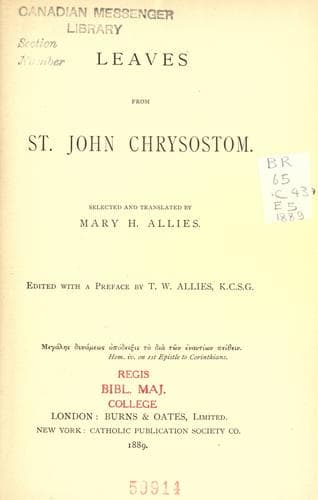
Leaves from St. John ChrysostomJohn Chrysostom, Saint
Religion
Leaves from St. John Chrysostom
John Chrysostom, Saint
Christian literature, Early; John Chrysostom, Saint, -407
clothes, and chattels, no one of them ever by his blood; yet Christ gave
us even this proof of His solicitude and His burning love for us. Thus,
in the old Law, as men were in an imperfect state and offered blood to
idols, it remained for Him to receive this (the chalice of the Pasch)
that He might turn them away from idols, which, again, was an ineffable
tenderness. But here He led them up to a far more awful and magnificent
worship of God, and changed the sacrifice itself, and instead of the
slaughtering of unreasoning animals, He commanded them to offer up
Himself. _Is not the bread which we break the communion of the Body of
Christ?_ Why did he not say a participation? Because he wished to set
forth something more and to show the closeness of that union. For we
communicate not only by receiving and participating, but by being made
one with Him. For just as that body is united to Christ, so are we made
one with Him through this bread. Why did he add, _which we break_? This
is seen to take place in the case of the Eucharist, though not at the
Cross, but the contrary. _Not a bone of Him shall be broken_, the
Scripture says. That which He did not suffer on the cross He suffers in
the Eucharist for your sake, and He endures being broken that He may
fill all.
Then after saying _the communion of the body_—for that which
communicates is something distinct from the thing communicated—he
removed even this seemingly slight difference. For in the words
_communion of the body_ he sought to say something closer, and therefore
added, _That we, being many, are one bread and one body_. ‘Why do I
speak of communion?’ he says; ‘we are that very Body itself. For what is
the bread? The Body of Christ. What do partakers of it become? The Body
of Christ: not many bodies, but one body.’ Just as bread is composed of
many grains of wheat which are nowhere apparent in it, but still there,
presenting no difference by reason of the kneading, so are we joined
together with each other and with Christ. You are not nourished by one
body and another man by another, but all by the same; therefore he
added, ‘We are all participators of the same bread’. But if we _are_ of
the same, and become the same, why do we not all show forth the same
charity and become one in this respect also? For this was so formerly in
our progenitors. _There was one heart and one mind in the gathering of
the faithful._ This is not the case now, but very much the reverse.
Dissensions are many and various and well-nigh everywhere, and we show
ourselves fiercer than wild beasts towards our members. Christ united
you to Himself when you were so distant, and you will not deign to be
united with your brother as you ought to be, but thrust yourself away
from him, whilst enjoying so great a love and life from your Master. It
was not for no purpose that He gave His Body, but as the first human
nature, which was made from the earth, became by sin subject to death
Public-domain text, read in full here on John Shaqi.
Reviews
Reviews
No reviews yet
Be the first to share your thoughts on this work.
Elsewhere in the archive
Join the Discussion
Join the discussion
Sign in to leave a comment or review.
Sign InorCreate an account