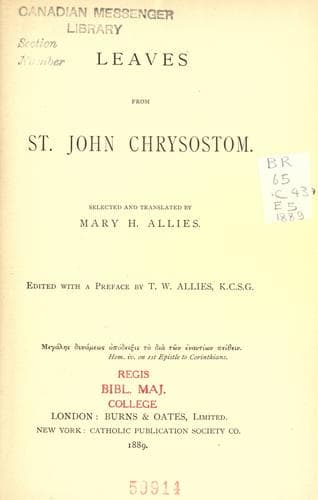
Leaves from St. John ChrysostomJohn Chrysostom, Saint
Religion
Leaves from St. John Chrysostom
John Chrysostom, Saint
Christian literature, Early; John Chrysostom, Saint, -407
Do not be sad; do not put down the beautiful death of your happy
daughter to your sins. She has reached the waveless shore and come to
everlasting life. Removed from the troubled waters of this present life,
she stands upon the rock, and whatever good things she has gathered
together, those she holds as a most secure treasure. You should rejoice
and exult and be glad that, like an intelligent gardener gathering the
ripe fruit, you have offered her soul to the common Lord of all.
Applying the remedy of such thoughts as these to yourself and to my most
honoured lady, her mother, increase the reward reserved to you under
these circumstances, so that not only on account of her excellent early
training, but also for humbly and thankfully bearing her happy departure
hence, you may receive a great crown from our merciful God.
To Olympias, A.D. 404.
(_On the Virginal Life_, ii., t. iii., p. 542.)
· · · · · · ·
Virginity is so great a thing, and requires so much labour, that when
Christ had come down from heaven in order to make men angels, and to sow
the heavenly life on earth, He did not venture even then to enjoin it or
to make a law of it, but He _did_ teach death to self, than which there
is nothing harder. He taught men to crucify themselves, always to do
good to their enemies, yet He did not make a law of virginity. He left
it to the free-will of His hearers, saying, _Let him who can, take it._
It is a weighty undertaking: it has arduous wrestlings with the sweat of
combat, and its path is rugged and precipitous. This is plainly shown by
those in the Old Law, who were full of good deeds. For Moses, that great
man who summed up the prophets in his person, the intimate friend of
God, who enjoyed so much favour with Him as to be able to snatch six
hundred thousand from the chastisement of a divine stroke, and was so
great as to command the sea, who parted the ocean, drew water from the
rock, and transformed the atmosphere, who changed the Nile’s waters into
blood, who opposed Pharaoh with an army of frogs and locusts, and
changed the whole face of creation, and worked a thousand other wonders,
and many virtuous deeds,—for he was remarkable in every way,—yet he
could not even look at _these_ wrestlings, but needed marriage and the
society of his wife, with its security. He dared not launch himself on
the ocean of virginity fearing its waves. Then there was the patriarch
who immolated his son and was strong enough to tread upon the most
tyrannical of nature’s feelings. He had courage to sacrifice his son,
that son being Isaac, in the bloom of his age, in the very flower of his
youth, his own and only-begotten son, vouchsafed to him contrary to all
hope, and full of righteousness, his one stay in his old age. He it was
who led this son forth to the mountain for that consummation, and
prepared the altar and laid the wood upon it, who placed the victim in
Public-domain text, read in full here on John Shaqi.
Reviews
Reviews
No reviews yet
Be the first to share your thoughts on this work.
Elsewhere in the archive
Join the Discussion
Join the discussion
Sign in to leave a comment or review.
Sign InorCreate an account