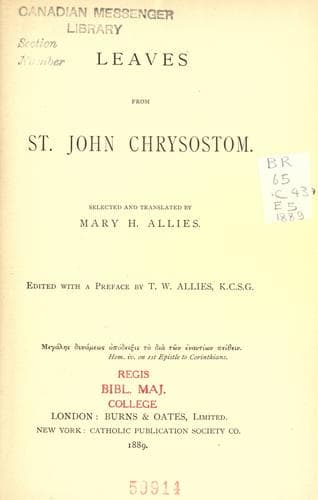
Leaves from St. John ChrysostomJohn Chrysostom, Saint
Religion
Leaves from St. John Chrysostom
John Chrysostom, Saint
Christian literature, Early; John Chrysostom, Saint, -407
and mercy of our Lord Jesus Christ, to Whom be glory and might, now and
for ever and ever. Amen.
FOOTNOTES
[1]Card. Newman.
[2]Palladius, _Life of St. Chrysostom_, in his works, vol. xiii., pp.
39, 40.
[3]In writing the above sketch, Nirschl’s _Lehrbuch der Patrologie und
Patristik_ has been used, and Cardinal Newman’s notice of the Saint
quoted once or twice, and everywhere borne in mind.
[4]Translated from the Greek Oxford and Cambridge Edition
[5]Translated from the Greek Oxford Edition.
[6]Compare ἀλλ’ ἤτοι µὲν ταῦτα Θεῶν ἐν γούνασι κεῖται (Ἰλιαδος P. 514).
[7]St. Chrysostom here refers from memory to the _Acts_, where Peter and
_John_ are spoken of as “illiterate and ignorant men” (c. iv., v.
13).
[8]Translated from Greek Benedictine Edition in folio, tom. ii., p. 2.
[9]I have ventured to change ἐννατήν into _another_. It is part of a
long argument.
[10]δεκάτην αἰτίαν.
[11]Compare with St. Augustine, _Da amantem et sentit quod dico_.
[12]Translated from the Greek Benedictine Edition in folio.
[13]Compare with St. Augustine: Unde temporibus eruditis, et omne quod
fieri non potest respuentibus, sine ullis miraculis nimium
mirabiliter incredibilia credidit mundus?—_De Civitate Dei_, l.
xxii., c. viii.
[14]Μὰλλον δὲ οὐκ αὐτοὶ µόνοι, ἀλλὰ καὶ ὁ πάντων κορυφαῖος Πέτρος.
[15]Ὅµιλια προ τῆς ἐξορίας. Benedictine Edition. There is a doubt about
the authenticity of the latter part of this Homily, which has not
been translated.
[16]Ἐκκλησίας δὲ σάρκα ἀνέλαβε.
[17]Translated from the Greek German Edition, Περὶ Ἱερωσυνῆς. Leipzig,
1872.
[18]See Ezekiel, c. xxxiii., v. 6.
[19]Benedictine Edition, t. xii., p. 167.
[20]Greek Oxford Edition.
[21]Ἀλλ’ αὐτὸς ὁ σταυρωθεὶς ὑπὲρ ἡµῶν Χριστός.
[22]... µεταῤῥυθµίζει τὰ προκείµενα.
[23]The single word _altar_ has to stand for the Greekβωµός and
θυσιαστήριον, the former meaning the altar on which a bloody
offering is made, the latter the altar on which the sacrifice after
the order of Melchisedec is offered.
[24]P. 295 of the same Homily.
[25]Blessed Thomas More’s words to his wife will here occur to many:
‘How long, thinkest thou, I might still live?’ and when she replied,
‘Full twenty years, if it so pleases God,’ answered, ‘Should I give
up eternity for twenty years?’
[26]Benedictine Edition, tom. iii., p. 515. St. Chrysostom wrote this
letter, A.D. 404, before his second exile, from which he never
returned. Copies of it were sent to the Archbishops of Milan and
Aquileia.
[27]The _Curiosi_ were officers whose business it was to pursue crime
and treason of all kinds, and to summon and denounce the guilty to
the emperor.—_Benedictine’s note._
[28]Holy Saturday.
[29]Uninitiated (ἀµύητοι ἦσαν), to speak the language of that day.
Public-domain text, read in full here on John Shaqi.
Reviews
Reviews
No reviews yet
Be the first to share your thoughts on this work.
Elsewhere in the archive
Join the Discussion
Join the discussion
Sign in to leave a comment or review.
Sign InorCreate an account