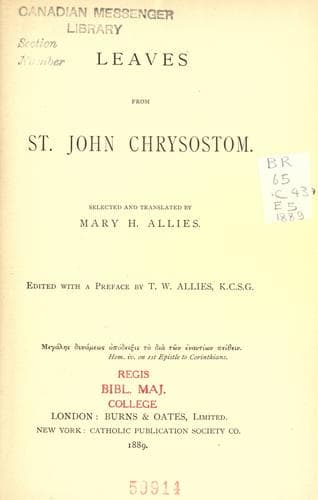
Leaves from St. John ChrysostomJohn Chrysostom, Saint
Religion
Leaves from St. John Chrysostom
John Chrysostom, Saint
Christian literature, Early; John Chrysostom, Saint, -407
Since, therefore, we melt down the gold of the Apostle’s mines, not
throwing it into the furnace, but putting it by in the understanding of
our soul, not enkindling a flame, but the fire of the Spirit, let us
pick up diligently even the tiny shavings. For if the word is brief, its
power is great. If the special worth of pearls lies not in their bulk
but in their beauty, so is it in the reading of the Divine Scriptures.
On the one hand, secular education has a care for much that is trifling,
is full of silly talk to its pupils, and sends them away empty-handed,
without gain small or great. It is not so with the grace of the Spirit,
but just the contrary. By a few words it brings asceticism before all,
and often one word is sufficient for the provision of a whole lifetime.
Since we have this wealth before us, let us rouse ourselves, and receive
these words with a pure mind. And I am prepared to show that this word
(of St. Paul to St. Timothy) contains a great deal. This advice has
seemed to many superfluous and trifling, and they make some such remark
as, ‘Might not Timothy have known himself how much wine he was to take,
without waiting to be told it by his master?’ Now, as the master not
only gave the order, but enforced it by letter, as on a metal slab, in
the epistle which he wrote to him, was he not ashamed to establish a
rule for such things in writing to his disciple? Learn, then, that this
advice, far from being superfluous, was necessary and most useful. It is
not Paul’s doing, but the grace of the Spirit. I am speaking not only of
its having been said, but also of its having been made emphatic in
writing, and published by this same epistle to all future generations. I
shall come presently to this proof. Together with the remarks I have
noted, some people question another and a not less important point,
asking themselves why God allowed a man of so great courage, whose bones
and body put forth devils, to fall into this great bodily weakness; for
he was not merely ill, he was always and persistently ill with illnesses
following close upon each other, so as to leave him no breathing time.
How do we know this? From Paul’s own words; for he did not say, _because
of thy infirmity_, nor thy infirmities alone, but to show that they were
constant he said, _thy frequent infirmities_. Let as many as are given
up to a long sickness, and are in great distress and weariness, listen
to this. Our enquiry does not concern itself only with the fact that,
being a holy man, he was sick, or that he was so thus constantly, but
that he was entrusted with the concerns of the world. If he had been one
of those dwellers on the mountain heights, or bound fast to a tent in
the desert, and thus leading a life without business, the question would
be less puzzling; but exposed to view as he was, with the cares of
churches so great upon him, traversing entire cities and countries, and
the whole world itself, with so much readiness, that _he_ should have
Public-domain text, read in full here on John Shaqi.
Reviews
Reviews
No reviews yet
Be the first to share your thoughts on this work.
Join the Discussion
Join the discussion
Sign in to leave a comment or review.
Sign InorCreate an account