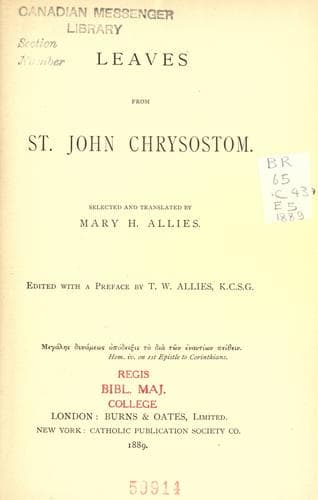
Leaves from St. John ChrysostomJohn Chrysostom, Saint
Religion
Leaves from St. John Chrysostom
John Chrysostom, Saint
Christian literature, Early; John Chrysostom, Saint, -407
pungent than that abundance? What is more humiliating than to be the man
thus noted and pointed at by everyone as the ‘man who became rich
through his wife’. I would set forth the domestic vexations which would
of necessity befal this man from his act, viz., his wife’s temper, his
state of slavery, their contentions, the scoffs of servants who call him
‘a poor beggar, a nobody sprung from nowhere, for what had he to offer?
Did not everything belong to the lady?’ But these words make no
impression on you, for you have not an independent spirit. Since
toad-eaters, too, have to hear what is still more outrageous, and do not
care, so neither are these men troubled, but they glory in their
shamelessness, and when we talk to them about it, one of them answers,
‘Let me alone, it is very pleasant; and it can put an end to me for all
I care’. Oh! the malice of the devil for making certain sayings
commonplaces in life, which are capable of poisoning the whole existence
of such men. See, at least, what deadly havoc this one diabolical phrase
works; for it says in so many words, ‘Have no care for sobriety or for
justice: let everything of the kind be thrown aside, and look only for
one thing—pleasure’. Even if this pursuit oppress you, choose it; even
if all who meet you spit upon you, and throw mud in your eyes, and drive
you about like a dog, bear it. What else could swine say if they had a
voice? or unclean dogs? Indeed, often _they_ would not give voice to
those things which the devil has induced men to rave about. Therefore I
strongly advise those who know the heartlessness of these words to fly
from such proverbial sayings, and to confute them by the contrary ones
of Holy Scripture. Which are they? _Go not after thy lusts, and turn
away from thy own will._ And, again, concerning the harlot, its words
are opposed to that other phrase: _Mind not the deceit of a woman. For
the lips of a harlot are like a honeycomb dropping, and her throat is
smoother than oil. But her end is bitter as wormwood, and sharp as a
two-edged sword._ Let us listen to these, and not to those words. For on
the latter base-minded and servile men ground their sophistry; hence, in
this, men become unreasoning things, in that they elect to seek pleasure
everywhere according to the world’s standard, which is despicable even
apart from our showing. For after the surfeiting, what is the gain of a
sweet taste? Cease, then, from this mirth, and from committing
yourselves to hell and the unquenchable fire, and let us look forward as
we ought to the things to come, putting off the scales from our eyes, so
that we may reach that future life in due time in great piety and
contentment, and may gain its good things through the love and kindness
of Our Lord Jesus Christ, to Whom be power for ever and ever. Amen.
“Use a Little Wine.”
(_Homilies de Statuis_,[8] xxi., _preached at Antioch_, tom. ii., p. 2.)
· · · · · · ·
Public-domain text, read in full here on John Shaqi.
Reviews
Reviews
No reviews yet
Be the first to share your thoughts on this work.
Join the Discussion
Join the discussion
Sign in to leave a comment or review.
Sign InorCreate an account