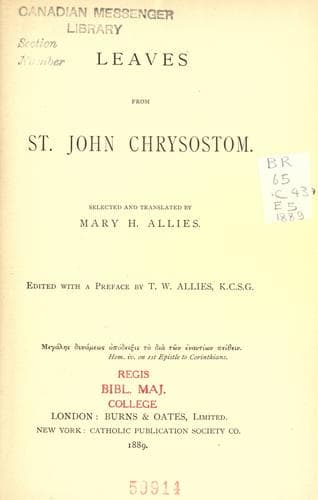
Leaves from St. John ChrysostomJohn Chrysostom, Saint
Religion
Leaves from St. John Chrysostom
John Chrysostom, Saint
Christian literature, Early; John Chrysostom, Saint, -407
Now, Timothy had all this before him, and he fortified himself on all
sides; for he knew that youth is hard to manage: unstable, easily
deceived, unsteady, and that it needs a strong bridle; for it is a pyre
which embraces all external things and is easily ignited. Therefore, he
was careful to put a check upon it on all sides, and he tried in every
way to quench this fire, and he drove the horse, which was unruly and
refractory, with much spirit, until he had broken him in and made him
obedient, and brought a strong hand to bear upon him, so that he
listened to reason’s word of command: ‘Let my body be weak but not my
soul,’ he said. ‘Let the flesh be bridled, and my soul in its course
heavenwards not be impeded.’ Together with this, what we should
especially wonder at in him was, that weakened down as he thus was, and
fighting with weakness, he did not neglect God’s work, but was more
active than those in full and robust health. He was seen with his
master, now at Ephesus, now at Corinth, often in Macedonia, in Italy,
everywhere by land and by sea, ever taking part in his toils and in his
continual dangers, nor did his weakness of body get the better of his
asceticism of spirit. This is zeal according to God, which makes
high-soaring easy. Thus, they who are in good case and sound in body
will gain nothing by it if their soul be cast down, and soft, and
slothful; so the weak will not be harmed by their want of health if
their soul be strong and alert. Now, this advice and counsel seem to
some to warrant unlimited wine-drinking, which is by no means the case.
If anyone would weigh the word carefully, he would find it is rather an
exhortation to fasting. For consider, this advice of Paul’s was given
not from the first and at the outset. It was given when he knew that
Timothy’s whole strength was broken, and even then not unrestrictedly,
but with a condition. He did not merely say, _Use wine_, but, _a little
wine_, and this not because Timothy required the advice, but because
_we_ do. Therefore, in writing to him, he limits and restricts
wine-drinking, telling him to drink as much as would overcome weakness,
and restore health to the body; not what would encourage another
complaint. Immoderate wine-drinking breeds complaints no less than
excessive water-drinking, or rather much worse ones, both in soul and
body. It incites the war of passions, and leads a tempest of foolish
fancies into the mind, weakens and enervates strength of body. An
abundance of water falling on the earth does not more persistently break
up the soil than constant wine-drinking does bodily strength by
weakening and wasting it. Let us, therefore, avoid both extremes, and
take care of our health, whilst we keep it within due bounds. For wine
was given us by God, not that we should be drunk with it, but that we
should be temperate, that we should be made glad and not sorry. _Wine
rejoices the heart of man_, the Scripture says. Now, you turn it into a
course for despondency.
Public-domain text, read in full here on John Shaqi.
Reviews
Reviews
No reviews yet
Be the first to share your thoughts on this work.
Elsewhere in the archive
Join the Discussion
Join the discussion
Sign in to leave a comment or review.
Sign InorCreate an account