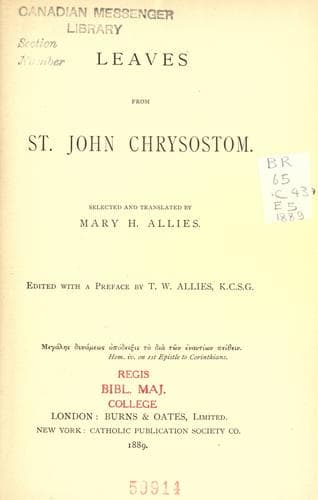
Leaves from St. John ChrysostomJohn Chrysostom, Saint
Religion
Leaves from St. John Chrysostom
John Chrysostom, Saint
Christian literature, Early; John Chrysostom, Saint, -407
‘And why should I suffer,’ you ask, ‘since this is no age for
martyrdom?’ What are you saying, ‘This is no age for martyrdom’? It has
never ceased, but is always before our eyes if we will be on the
look-out. It is not only hanging on the wood which makes a martyr, for
if this were the case, Job would be deprived of this particular crown.
He neither appeared at a judgment-seat, nor heard the voice of a judge,
nor saw an executioner, nor raised in the air and disjointed on the
cross, were his ribs worn away. Yet he bore stripes harder than many
martyrs did, and the voices of ceaseless messengers urged and tormented
him more sharply than any stripes, and those worms devoured his flesh
more rapidly than countless executioners. Was he then not fully equal to
a martyr? He _was_ a thousand times a martyr. He wrestled in every
single way, and was crowned; he was tried by money losses, and by
children, and bodily sickness, and wife, and friends, and enemies, and
servants, for they also insulted him to his face; by hunger, and curses,
and pains, and stench. On this account I should say that he would equal
not one, or two, or three, but many martyrs. Besides all this, the time
added greatly to his crowns: for instance, it was before the law and the
dispensation of grace, and he suffered during many months and with
intensity, and all his misfortunes were laid upon him at once, although
each was in itself overwhelming, and that which seemed the most grievous
of all, the loss of his wealth. Many at least have borne stripes but
have not borne the loss of property, and have chosen to be scourged for
it, and would rather have endured a thousand other evils than any
diminution of it, as the loss of money appeared to them the greater
stripe. So this constitutes another kind of martyrdom for the man who
bears its loss with endurance. And how shall we be sure of the
endurance, you ask? By understanding that you gain more than you have
lost by a single word, that of thanksgiving. If, when we hear of our
loss, we are not agitated, but say, ‘Praised be God,’ we have found
something of much greater worth. Indeed, you could not gain rewards so
high by distributing your riches to the poor, nor by going about to seek
out the needy, and by lavishing your good things upon them, as you gain
by this one word. Hence, I admire Job not so much when he opens his
house to the poor, as I proclaim and wonder at him for bearing the loss
of his wealth with thanksgiving. The same is evident in the case of his
children’s death. You will receive a reward not less than his was who
led out his son to sacrifice him, if seeing _yours_ dead, you give
thanks to the God of mercy. How is such a man less than Abraham? He did
not see _his_ son lying dead, but only expected it; so that if he
carries off the palm for his readiness to sacrifice, and for putting out
his hand to seize the knife, he is surpassed by the fact of _your_ son
being actually a corpse before your eyes.
Public-domain text, read in full here on John Shaqi.
Reviews
Reviews
No reviews yet
Be the first to share your thoughts on this work.
Elsewhere in the archive
Join the Discussion
Join the discussion
Sign in to leave a comment or review.
Sign InorCreate an account