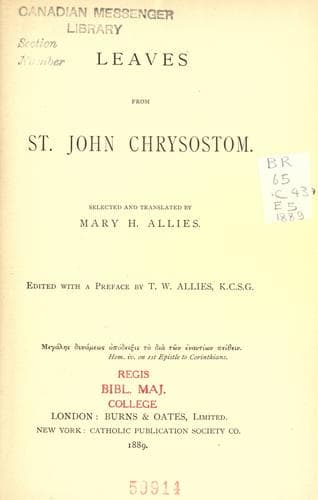
Leaves from St. John ChrysostomJohn Chrysostom, Saint
Religion
Leaves from St. John Chrysostom
John Chrysostom, Saint
Christian literature, Early; John Chrysostom, Saint, -407
Therefore, do not let us call Him to account for what has happened, but
glorify Him in all things. For not by chance, or in vain, does He allow
such things often to come about, nor does He despise those who are to
enjoy solace from money, but instead of this He puts another means of
support in their way, and, besides the trial, gives the shipwrecked man
a greater reward. Indeed, giving thanks to God in trials of this kind is
much higher than alms, for we do not give by alms alone, but if we bear
bravely the losses inflicted by others, we shall gain immense fruit from
it. In order to prove this to you I will make it clear to you from what
happened to Job that patience is better than alms-giving. When Job was
rich, he opened his house to the poor and gave away all that he
possessed, but he was not so magnificent at the time he was opening his
house to the needy, as when he heard unmoved that it had fallen to the
ground: he was not so renowned when he covered the naked with the fleece
of his sheep as when, hearing that fire had broken out and consumed all
his cattle, he gave thanks. _Then_ he was kind, now he became mortified:
_then_ he had compassion on the poor, now he gave thanks to his Lord.
Nor did he say to himself: ‘What is the meaning of this? The sheep, from
which thousands of poor were fed, are destroyed: for if _I_ was unworthy
to enjoy this abundance, I should have been spared, at least, for the
sake of those who shared it.’ He neither said nor thought anything of
the sort, but he knew that God was ordering it all for the best. And to
show you that he beat the devil more effectually by giving thanks when
despoiled than by showing mercy when rich, consider that, at the time of
his wealth, the devil had some reason, even if falsely, for saying,
_Does Job worship Thee for nothing?_ Now when God took away everything,
and stripped him completely, and Job kept his good-will towards God,
then was that shameless mouth stopped, and he had nothing more to say:
that just man was more glorious than before. To bear with fortitude and
thanksgiving the being despoiled is a much greater thing than for a rich
man to give alms, as has been shown in the case of this just man. Then
his kindness to his fellow-man was overflowing, now he proved his
exceeding love for God. I insist on this, not without reason, but
because many men by frequent alms have supported widows, and then been
deprived of their substance. Others have lost everything through a fire
breaking out; others have encountered shipwreck; others through
slanderings and abuse have, after generous alms-giving, fallen into the
extreme of poverty, and into weakness and disease, and have been helped
by no one in any way. In order, therefore, that we should not say, as
many often do, ‘No man knows anything,’ what I have said will suffice to
put an end to this difficulty. ‘So and so, who gave so much in alms,’
you say, ‘lost everything.’ And what if he did? For, if he give thanks
Public-domain text, read in full here on John Shaqi.
Reviews
Reviews
No reviews yet
Be the first to share your thoughts on this work.
Elsewhere in the archive
Join the Discussion
Join the discussion
Sign in to leave a comment or review.
Sign InorCreate an account