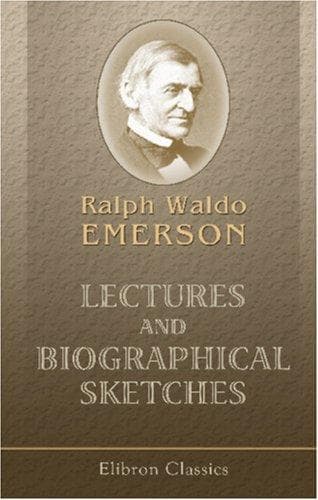
Lectures and biographical sketchesEmerson, Ralph Waldo
Philosophy
Lectures and biographical sketches
Emerson, Ralph Waldo
American essays -- 19th century; Speeches, addresses, etc., American -- 19th century
The Athenians took an oath, on a certain crisis in their affairs,
to esteem wheat, the vine and the olive the bounds of Attica. The
territory of scholars is yet larger. A stranger but yesterday to every
person present, I find myself already at home, for the society of
lettered men is a university which does not bound itself with the walls
of one cloister or college, but gathers in the distant and solitary
student into its strictest amity. Literary men gladly acknowledge these
ties which find for the homeless and the stranger a welcome where
least looked for. But in proportion as we are conversant with the
laws of life, we have seen the like. We are used to these surprises.
This is but one operation of a more general law. As in coming among
strange faces we find that the love of letters makes us friends, so in
strange thoughts, in the worldly habits which harden us, we find with
some surprise that learning and truth and beauty have not let us go;
that the spiritual nature is too strong for us; that those excellent
influences which men in all ages have called the _Muse_, or by
some kindred name, come in to keep us warm and true; that the face
of Nature remains irresistibly alluring. We have strayed from the
territorial monuments of Attica, but here still are wheat and olives
and the vine.
I do not now refer to that intellectual conscience which forms
itself in tender natures, and gives us many twinges for our sloth
and unfaithfulness:--the influence I speak of is of a higher strain.
Stung by this intellectual conscience, we go to measure our tasks
as scholars, and screw ourselves up to energy and fidelity, and our
sadness is suddenly overshone by a sympathy of blessing. Beauty, the
inspirer, the cheerful festal principle, the leader of gods and men,
which draws by being beautiful, and not by considerations of advantage,
comes in and puts a new face on the world. I think the peculiar
office of scholars in a careful and gloomy generation is to be (as
the poets were called in the Middle Ages) Professors of the Joyous
Science, detectors and delineators of occult symmetries and unpublished
beauties; heralds of civility, nobility, learning and wisdom; affirmers
of the one law, yet as those who should affirm it in music and dancing;
expressors themselves of that firm and cheerful temper, infinitely
removed from sadness, which reigns through the kingdoms of chemistry,
vegetation, and animal life. Every natural power exhilarates; a true
talent delights the possessor first. A celebrated musician was wont
to say, that men knew not how much more he delighted himself with
his playing than he did others; for if they knew, his hearers would
rather demand of him than give him a reward. The scholar is here to
fill others with love and courage by confirming their trust in the
love and wisdom which are at the heart of all things; to affirm noble
sentiments; to hear them wherever spoken, out of the deeps of ages, out
Public-domain text, read in full here on John Shaqi.
Reviews
Reviews
No reviews yet
Be the first to share your thoughts on this work.
Elsewhere in the archive
Join the Discussion
Join the discussion
Sign in to leave a comment or review.
Sign InorCreate an account