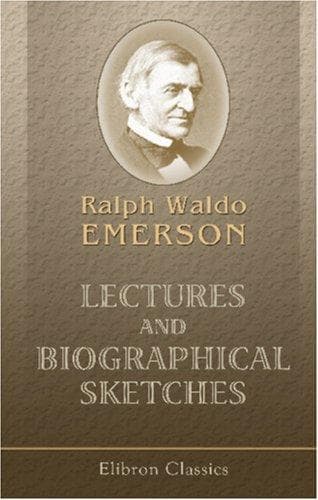
Lectures and biographical sketchesEmerson, Ralph Waldo
Philosophy
Lectures and biographical sketches
Emerson, Ralph Waldo
American essays -- 19th century; Speeches, addresses, etc., American -- 19th century
The shallow clamor against theoretic men comes from the weak. Able men
may sometimes affect a contempt for thought, which no able man ever
feels. For what alone in the history of this world interests all men in
proportion as they are men? What but truth, and perpetual advance in
knowledge of it, and brave obedience to it in right action? Every man
or woman who can voluntarily or involuntarily give them any insight or
suggestion on these secrets they will hearken after. The poet writes
his verse on a scrap of paper, and instantly the desire and love of all
mankind take charge of it, as if it were Holy Writ. What need has he
to cross the sill of his door? Why need he meddle with politics? His
idlest thought, his yesternight’s dream is told already in the Senate.
What the Genius whispered him at night he reported to the young men at
dawn. He rides in them, he traverses sea and land. The engineer in the
locomotive is waiting for him; the steamboat is hissing at the wharf,
and the wheels whirling to go. ’Tis wonderful, ’tis almost scandalous,
this extraordinary favoritism shown to poets. I do not mean to excuse
it. I admit the enormous partiality. It only shows that such is the
gulf between our perception and our painting, the eye is so wise, and
the hand so clumsy, that all the human race have agreed to value a man
according to his power of expression. For him arms, art, politics,
trade waited like menials, until the lord of the manor should arrive.
Even the demonstrations of nature for millenniums seem not to have
attained their end, until this interpreter arrives. “I,” said the
great-hearted Kepler, “may well wait a hundred years for a reader,
since God Almighty has waited six thousand years for an observer like
myself.”
Genius is a poor man and has no house, but see, this proud landlord who
has built the palace and furnished it so delicately, opens it to him
and beseeches him to make it honorable by entering there and eating
bread. Where is the palace in England whose tenants are not too happy
if it can make a home for Pope or Addison or Swift or Burke or Canning
or Tennyson? Or if wealth has humors and wishes to shake off the yoke
and assert itself,--oh, by all means let it try! Will it build its
fences very high, and make its Almacks too narrow for a wise man to
enter? Will it be independent? I incline to concede the isolation which
it asks, that it may learn that it is not independent but parasitical.
Public-domain text, read in full here on John Shaqi.
Reviews
Reviews
No reviews yet
Be the first to share your thoughts on this work.
Elsewhere in the archive
Join the Discussion
Join the discussion
Sign in to leave a comment or review.
Sign InorCreate an account