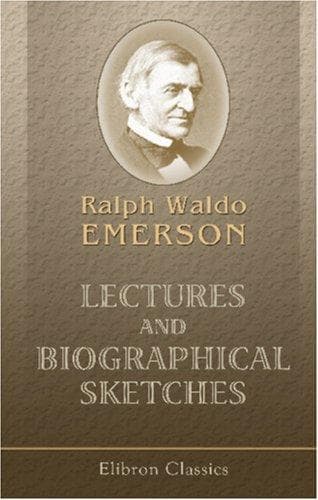
Lectures and biographical sketchesEmerson, Ralph Waldo
Philosophy
Lectures and biographical sketches
Emerson, Ralph Waldo
American essays -- 19th century; Speeches, addresses, etc., American -- 19th century
But this neglect by his contemporaries has been compensated by an
immense popularity in modern nations. Whilst his books were never known
to the world in their own Greek tongue, it is curious that the “Lives”
were translated and printed in Latin, thence into Italian, French,
and English, more than a century before the original “Works” were yet
printed. For whilst the “Lives” were translated in Rome in 1470, and
the “Morals,” part by part, soon after, the first printed edition of
the Greek “Works” did not appear until 1572. Hardly current in his own
Greek, these found learned interpreters in the scholars of Germany,
Spain and Italy. In France, in the middle of the most turbulent civil
wars, Amyot’s translation awakened general attention. His genial
version of the “Lives” in 1559, of the “Morals” in 1572, had signal
success. King Henry IV. wrote to his wife, Marie de Medicis: “_Vive
Dieu._ As God liveth, you could not have sent me anything which
could be more agreeable than the news of the pleasure you have taken
in this reading. Plutarch always delights me with a fresh novelty. To
love him is to love me; for he has been long time the instructor of
my youth. My good mother, to whom I owe all, and who would not wish,
she said, to see her son an illustrious dunce, put this book into my
hands almost when I was a child at the breast. It has been like my
conscience, and has whispered in my ear many good suggestions and
maxims for my conduct and the government of my affairs.” Still earlier,
Rabelais cites him with due respect. Montaigne, in 1589, says: “We
dunces had been lost, had not this book raised us out of the dirt. By
this favor of his we dare now speak and write. The ladies are able
to read to schoolmasters. ’Tis our breviary.” Montesquieu drew from
him his definition of law, and, in his _Pensées_, declares, “I
am always charmed with Plutarch; in his writings are circumstances
attached to persons, which give great pleasure;” and adds examples.
Saint Evremond read Plutarch to the great Condé under a tent. Rollin,
so long the historian of antiquity for France, drew unhesitatingly his
history from him. Voltaire honored him, and Rousseau acknowledged him
as his master. In England, Sir Thomas North translated the “Lives”
in 1579, and Holland the “Morals” in 1603, in time to be used by
Shakspeare in his plays, and read by Bacon, Dryden, and Cudworth.
Public-domain text, read in full here on John Shaqi.
Reviews
Reviews
No reviews yet
Be the first to share your thoughts on this work.
Elsewhere in the archive
Join the Discussion
Join the discussion
Sign in to leave a comment or review.
Sign InorCreate an account