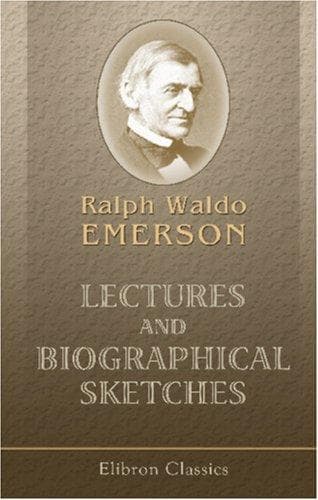
Lectures and biographical sketchesEmerson, Ralph Waldo
Philosophy
Lectures and biographical sketches
Emerson, Ralph Waldo
American essays -- 19th century; Speeches, addresses, etc., American -- 19th century
I do not know where to find a book--to borrow a phrase of Ben
Jonson’s--“so rammed with life,” and this in chapters chiefly ethical,
which are so prone to be heavy and sentimental. No poet could
illustrate his thought with more novel or striking similes or happier
anecdotes. His style is realistic, picturesque and varied; his sharp
objective eyes seeing everything that moves, shines, or threatens in
nature or art, or thought or dreams. Indeed, twilights, shadows, omens
and spectres have a charm for him. He believes in witchcraft and the
evil eye, in demons and ghosts,--but prefers, if you please, to talk
of these in the morning. His vivacity and abundance never leave him to
loiter or pound on an incident. I admire his rapid and crowded style,
as if he had such store of anecdotes of his heroes that he is forced to
suppress more than he recounts, in order to keep up with the hasting
history.
His surprising merit is the genial facility with which he deals with
his manifold topics. There is no trace of labor or pain. He gossips
of heroes, philosophers and poets; of virtues and genius; of love and
fate and empires. It is for his pleasure that he recites all that is
best in his reading: he prattles history. But he is no courtier, and
no Boswell: he is ever manly, far from fawning, and would be welcome
to the sages and warriors he reports, as one having a native right
to admire and recount these stirring deeds and speeches. I find him
a better teacher of rhetoric than any modern. His superstitions are
poetic, aspiring, affirmative. A poet might rhyme all day with hints
drawn from Plutarch, page on page. No doubt, this superior suggestion
for the modern reader owes much to the foreign air, the Greek wine,
the religion and history of antique heroes. Thebes, Sparta, Athens
and Rome charm us away from the disgust of the passing hour. But his
own cheerfulness and rude health are also magnetic. In his immense
quotation and allusion we quickly cease to discriminate between what
he quotes and what he invents. We sail on his memory into the ports
of every nation, enter into every private property, and do not stop
to discriminate owners, but give him the praise of all. ’Tis all
Plutarch, by right of eminent domain, and all property vests in this
emperor. This facility and abundance make the joy of his narrative,
and he is read to the neglect of more careful historians. Yet he
inspires a curiosity, sometimes makes a necessity, to read them. He
disowns any attempt to rival Thucydides; but I suppose he has a hundred
readers where Thucydides finds one, and Thucydides must often thank
Plutarch for that one. He has preserved for us a multitude of precious
sentences, in prose or verse, of authors whose books are lost; and
these embalmed fragments, through his loving selection alone, have come
to be proverbs of later mankind. I hope it is only my immense ignorance
that makes me believe that they do not survive out of his pages,--not
Public-domain text, read in full here on John Shaqi.
Reviews
Reviews
No reviews yet
Be the first to share your thoughts on this work.
Elsewhere in the archive
Join the Discussion
Join the discussion
Sign in to leave a comment or review.
Sign InorCreate an account