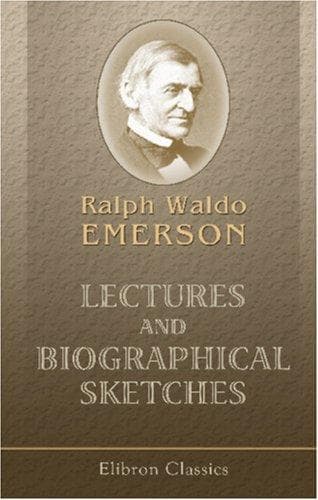
Lectures and biographical sketchesEmerson, Ralph Waldo
Philosophy
Lectures and biographical sketches
Emerson, Ralph Waldo
American essays -- 19th century; Speeches, addresses, etc., American -- 19th century
Aristotle than from his father Philip.” He thinks that “he who has
ideas of his own is a bad judge of another man’s, it being true that
the Eleans would be the most proper judges of the Olympic games, were
no Eleans gamesters.” He says of Socrates, that he endeavored to bring
reason and things together, and make truth consist with sober sense. He
wonders with Plato at that nail of pain and pleasure which fastens the
body to the mind. The mathematics give him unspeakable pleasure, but he
chiefly liked that proportion which teaches us to account that which is
just, equal; and not that which is equal, just.
Of philosophy he is more interested in the results than in the method.
He has a just instinct of the presence of a master, and prefers
to sit as a scholar with Plato, than as a disputant; and, true to
his practical character, he wishes the philosopher not to hide in a
corner, but to commend himself to men of public regards and ruling
genius: “for, if he once possess such a man with principles of honor
and religion, he takes a compendious method, by doing good to one, to
oblige a great part of mankind.” ’Tis a temperance, not an eclecticism,
which makes him adverse to the severe Stoic, or the Gymnosophist, or
Diogenes, or any other extremist. That vice of theirs shall not hinder
him from citing any good word they chance to drop. He is an eclectic
in such sense as Montaigne was,--willing to be an expectant, not a
dogmatist.
In many of these chapters it is easy to infer the relation between the
Greek philosophers and those who came to them for instruction. This
teaching was no play nor routine, but strict, sincere and affectionate.
The part of each of the class is as important as that of the master.
They are like the base-ball players, to whom the pitcher, the bat, the
catcher and the scout are equally important. And Plutarch thought, with
Ariston, “that neither a bath nor a lecture served any purpose, unless
they were purgative.” Plutarch has such a keen pleasure in realities
that he has none in verbal disputes; he is impatient of sophistry, and
despises the Epicharmian disputations: as, that he who ran in debt
yesterday owes nothing to-day, as being another man; so, he that was
yesterday invited to supper, the next night comes an unbidden guest,
for that he is quite another person.
Public-domain text, read in full here on John Shaqi.
Reviews
Reviews
No reviews yet
Be the first to share your thoughts on this work.
Elsewhere in the archive
Join the Discussion
Join the discussion
Sign in to leave a comment or review.
Sign InorCreate an account