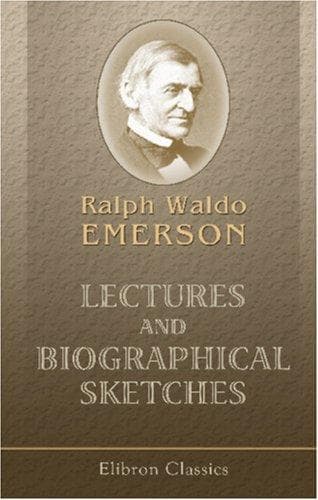
Lectures and biographical sketchesEmerson, Ralph Waldo
Philosophy
Lectures and biographical sketches
Emerson, Ralph Waldo
American essays -- 19th century; Speeches, addresses, etc., American -- 19th century
All his judgments are noble. He thought, with Epicurus, that it is more
delightful to do than to receive a kindness. “This courteous, gentle,
and benign disposition and behavior is not so acceptable, so obliging
or delightful to any of those with whom we converse, as it is to those
who have it.” There is really no limit to his bounty: “It would be
generous to lend our eyes and ears, nay, if possible, our reason and
fortitude to others, whilst we are idle or asleep.” His excessive and
fanciful humanity reminds one of Charles Lamb, whilst it much exceeds
him. When the guests are gone, he “would leave one lamp burning, only
as a sign of the respect he bore to fires, for nothing so resembles
an animal as fire. It is moved and nourished by itself, and by its
brightness, like the soul, discovers and makes everything apparent, and
in its quenching shows some power that seems to proceed from a vital
principle, for it makes a noise and resists, like an animal dying,
or violently slaughtered;” and he praises the Romans, who, when the
feast was over, “dealt well with the lamps, and did not take away the
nourishment they had given, but permitted them to live and shine by it.”
I can almost regret that the learned editor of the present
republication has not preserved, if only as a piece of history,
the preface of Mr. Morgan, the editor and in part writer of this
Translation of 1718. In his dedication of the work to the Archbishop
of Canterbury, Wm. Wake, he tells the Primate that “Plutarch was the
wisest man of his age, and, if he had been a Christian, one of the
best too; _but it was his severe fate to flourish in those days of
ignorance, which, ’tis a favorable opinion to hope that the Almighty
will sometime wink at; that our souls may be with these philosophers
together in the same state of bliss_.” The puzzle in the worthy
translator’s mind between his theology and his reason well reappears in
the puzzle of his sentence.
I know that the chapter of “Apothegms of Noble Commanders” is rejected
by some critics as not a genuine work of Plutarch; but the matter is
good, and is so agreeable to his taste and genius, that if he had found
it, he would have adopted it. If he did not compile the piece, many,
perhaps most of the anecdotes were already scattered in his works.
If I do not lament that a work not his should be ascribed to him, I
regret that he should have suffered such destruction of his own. What
a trilogy is lost to mankind in his Lives of Scipio, Epaminondas, and
Pindar!
Public-domain text, read in full here on John Shaqi.
Reviews
Reviews
No reviews yet
Be the first to share your thoughts on this work.
Elsewhere in the archive
Join the Discussion
Join the discussion
Sign in to leave a comment or review.
Sign InorCreate an account