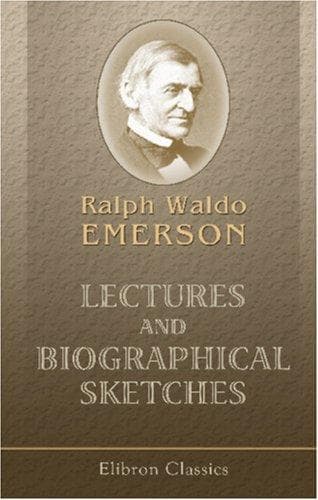
Lectures and biographical sketchesEmerson, Ralph Waldo
Philosophy
Lectures and biographical sketches
Emerson, Ralph Waldo
American essays -- 19th century; Speeches, addresses, etc., American -- 19th century
Whether from these influences, or whether by a reaction of the general
mind against the too formal science, religion and social life of the
earlier period,--there was, in the first quarter of our nineteenth
century, a certain sharpness of criticism, an eagerness for reform,
which showed itself in every quarter. It appeared in the popularity
of Lavater’s Physiognomy, now almost forgotten. Gall and Spurzheim’s
Phrenology laid a rough hand on the mysteries of animal and spiritual
nature, dragging down every sacred secret to a street show. The attempt
was coarse and odious to scientific men, but had a certain truth in it;
it felt connection where the professors denied it, and was a leading
to a truth which had not yet been announced. On the heels of this
intruder came Mesmerism, which broke into the inmost shrines, attempted
the explanation of miracle and prophecy, as well as of creation. What
could be more revolting to the contemplative philosopher! But a certain
success attended it, against all expectation. It was human, it was
genial, it affirmed unity and connection between remote points, and
as such was excellent criticism on the narrow and dead classification
of what passed for science; and the joy with which it was greeted
was an instinct of the people which no true philosopher would fail to
profit by. But while society remained in doubt between the indignation
of the old school and the audacity of the new, a higher note sounded.
Unexpected aid from high quarters came to iconoclasts. The German
poet Goethe revolted against the science of the day, against French
and English science, declared war against the great name of Newton,
proposed his own new and simple optics: in Botany, his simple theory
of metamorphosis;--the eye of a leaf is all; every part of the plant
from root to fruit is only a modified leaf, the branch of a tree is
nothing but a leaf whose serratures have become twigs. He extended this
into anatomy and animal life, and his views were accepted. The revolt
became a revolution. Schelling and Oken introduced their ideal natural
philosophy, Hegel his metaphysics, and extended it to Civil History.
The result in literature and the general mind was a return to law;
in science, in politics, in social life; as distinguished from the
profligate manners and politics of earlier times. The age was moral.
Every immorality is a departure from nature, and is punished by natural
loss and deformity. The popularity of Combe’s Constitution of Man;
the humanity which was the aim of all the multitudinous works of
Dickens; the tendency even of Punch’s caricature, was all on the side
of the people. There was a breath of new air, much vague expectation, a
consciousness of power not yet finding its determinate aim.
Public-domain text, read in full here on John Shaqi.
Reviews
Reviews
No reviews yet
Be the first to share your thoughts on this work.
Elsewhere in the archive
Join the Discussion
Join the discussion
Sign in to leave a comment or review.
Sign InorCreate an account