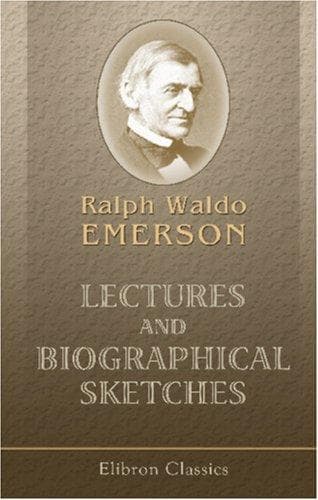
Lectures and biographical sketchesEmerson, Ralph Waldo
Philosophy
Lectures and biographical sketches
Emerson, Ralph Waldo
American essays -- 19th century; Speeches, addresses, etc., American -- 19th century
Some time afterwards Dr. Channing opened his mind to Mr. and Mrs.
Ripley, and with some care they invited a limited party of ladies
and gentlemen. I had the honor to be present. Though I recall the
fact, I do not retain any instant consequence of this attempt, or any
connection between it and the new zeal of the friends who at that time
began to be drawn together by sympathy of studies and of aspiration.
Margaret Fuller, George Ripley, Dr. Convers Francis, Theodore Parker,
Dr. Hedge, Mr. Brownson, James Freeman Clarke, William H. Channing,
and many others, gradually drew together and from time to time spent
an afternoon at each other’s houses in a serious conversation. With
them was always one well-known form, a pure idealist, not at all a
man of letters, nor of any practical talent, nor a writer of books; a
man quite too cold and contemplative for the alliances of friendship,
with rare simplicity and grandeur of perception, who read Plato as an
equal, and inspired his companions only in proportion as they were
intellectual,--whilst the men of talent complained of the want of point
and precision in this abstract and religious thinker.
These fine conversations, of course, were incomprehensible to some
in the company, and they had their revenge in their little joke.
One declared that “It seemed to him like going to heaven in a
swing;” another reported that, at a knotty point in the discourse,
a sympathizing Englishman with a squeaking voice interrupted with
the question, “Mr. Alcott, a lady near me desires to inquire whether
omnipotence abnegates attribute?”
I think there prevailed at that time a general belief in Boston that
there was some concert of _doctrinaires_ to establish certain
opinions and inaugurate some movement in literature, philosophy,
and religion, of which design the supposed conspirators were quite
innocent; for there was no concert, and only here and there two or
three men or women who read and wrote, each alone, with unusual
vivacity. Perhaps they only agreed in having fallen upon Coleridge and
Wordsworth and Goethe, then on Carlyle, with pleasure and sympathy.
Otherwise, their education and reading were not marked, but had the
American superficialness, and their studies were solitary. I suppose
all of them were surprised at this rumor of a school or sect, and
certainly at the name of Transcendentalism, given nobody knows by whom,
or when it was first applied. As these persons became in the common
chances of society acquainted with each other, there resulted certainly
strong friendships, which of course were exclusive in proportion to
their heat: and perhaps those persons who were mutually the best
friends were the most private and had no ambition of publishing their
letters, diaries, or conversation.
Public-domain text, read in full here on John Shaqi.
Reviews
Reviews
No reviews yet
Be the first to share your thoughts on this work.
Elsewhere in the archive
Join the Discussion
Join the discussion
Sign in to leave a comment or review.
Sign InorCreate an account