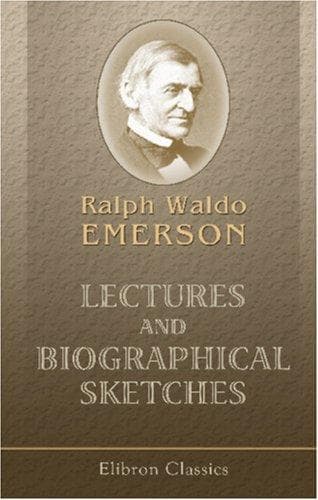
Lectures and biographical sketchesEmerson, Ralph Waldo
Philosophy
Lectures and biographical sketches
Emerson, Ralph Waldo
American essays -- 19th century; Speeches, addresses, etc., American -- 19th century
These reformers were a new class. Instead of the fiery souls of the
Puritans, bent on hanging the Quaker, burning the witch and banishing
the Romanist, these were gentle souls, with peaceful and even with
genial dispositions, casting sheep’s-eyes even on Fourier and his
houris. It was a time when the air was full of reform. Robert Owen of
Lanark came hither from England in 1845, and read lectures or held
conversations wherever he found listeners; the most amiable, sanguine
and candid of men. He had not the least doubt that he had hit on a
right and perfect socialism, or that all mankind would adopt it. He
was then seventy years old, and being asked, “Well, Mr. Owen, who is
your disciple? How many men are there possessed of your views who
will remain after you are gone, to put them in practice?” “Not one,”
was his reply. Robert Owen knew Fourier in his old age. He said that
Fourier learned of him all the truth he had; the rest of his system
was imagination, and the imagination of a banker. Owen made the best
impression by his rare benevolence. His love of men made us forget his
“Three Errors.” His charitable construction of men and their actions
was invariable. He was the better Christian in his controversy with
Christians, and he interpreted with great generosity the acts of the
“Holy Alliance,” and Prince Metternich, with whom the persevering
_doctrinaire_ had obtained interviews; “Ah,” he said, “you may
depend on it there are as tender hearts and as much good will to serve
men, in palaces, as in colleges.”
And truly I honor the generous ideas of the Socialists, the
magnificence of their theories, and the enthusiasm with which they
have been urged. They appeared the inspired men of their time. Mr.
Owen preached his doctrine of labor and reward, with the fidelity and
devotion of a saint, to the slow ears of his generation. Fourier,
almost as wonderful an example of the mathematical mind of France as La
Place or Napoleon, turned a truly vast arithmetic to the question of
social misery, and has put men under the obligation which a generous
mind always confers, of conceiving magnificent hopes and making great
demands as the right of man. He took his measure of that which all
should and might enjoy, from no soup-society or charity-concert, but
from the refinements of palaces, the wealth of universities, and the
triumphs of artists. He thought nobly. A man is entitled to pure air,
and to the air of good conversation in his bringing up, and not, as
we or so many of us, to the poor-smell and musty chambers, cats and
fools. Fourier carried a whole French Revolution in his head, and much
more. Here was arithmetic on a huge scale. His ciphering goes where
ciphering never went before, namely, into stars, atmospheres, and
animals, and men and women, and classes of every character. It was the
most entertaining of French romances, and could not but suggest vast
possibilities of reform to the coldest and least sanguine.
Public-domain text, read in full here on John Shaqi.
Reviews
Reviews
No reviews yet
Be the first to share your thoughts on this work.
Elsewhere in the archive
Join the Discussion
Join the discussion
Sign in to leave a comment or review.
Sign InorCreate an account